|
Schweinfurt
Schweinfurt, an industrial city of some
52,000
people located on the Main River in northern Bavaria, was a center for the manufacture of
anti-friction bearings during World War II (and still is). As the U.S. 8th Air Force began to build
up its strength in England in 1943, planners wished to concentrate on bombing those
industrial targets that they felt would most hurt the German war effort, particularly the
enemy aircraft industry. Low-friction ball and roller bearings were used in all parts of
military and commercial machinery, and research indicated that roughly half of the German
bearing industry was located in Schweinfurt, concentrated at four or five factory sites on
the western side of town. The 8th Air Force planners felt that if they could strike hard
enough at Schweinfurt, the results might cripple the German war industry.
This page is divided into seven parts,
with two associated pages.
Part 1 - Introduction and bombing of the bearing factories (this page)
Part 2 - Bombing damage to the city, and memorials to the bombing victims
Part 3 - Flak (anti-aircraft) battery defenses of Schweinfurt
Part 4 - Air defense shelters throughout the city
Part 5 - End of the war in Schweinfurt (April 1945)
Part 6 - Schweinfurt under the Swastika (Nazi buildings, parades,
and ceremonies)
Part 7 - German
military in Schweinfurt (military barracks, Panzer Regiment 4, Panzer Regiment
36)
Luftwaffe ammunition storage
facility at Rottershausen
References for the Schweinfurt pages
Click
here for a link to a MapQuest map of Schweinfurt.

|
|

|
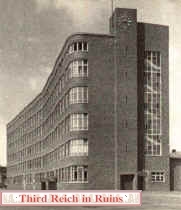
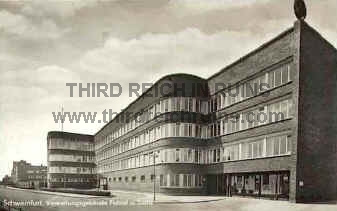
| The primary Schweinfurt
targets ... above, the Kugelfischer-Georg-Schäfer company, the largest bearing manufacturer in Schweinfurt (see
below). The administration
offices are seen at the left, with the Hochgebäude (high-rise building)
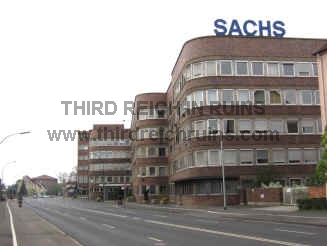
in the center (modern view at the right above). Below left, the administration buildings of the Fichtel &
Sachs company (see below);
below right, workers on the
bearing lines in one of the buildings of the Vereinigte Kugellagerfabriken (VKF) company
(see below). Note that although Fichtel & Sachs
were no
longer primarily a bearing producer by the start of World War II, the company did re-open
bearing lines during the war, and was targeted by Allied bombers as such.
(Note - This webpage uses the World War II names for the bearing
companies. None of these companies remains in the hands of the WW2 owners,
and some have changed names more than once. Kugelfischer is now called FAG-Kugelfischer,
Fichtel & Sachs is ZF-Sachs, and VKF is called SKF. Interestingly, the company became VKF
(Vereinigte Kugellagerfabriken) in 1929, but they were part of the SKF
conglomerate (Schwedische Kugellagerfabriken), and that name was commonly
used as well. However, during the war the Allies referred to this company
as VKF, as they did not want to appear to be bombing a Swedish company!)
(period photos of Kugelfischer Hochgebäude and VKF are from a 1936 info pamphlet on
Schweinfurt; others from period postcards; all in author's collection) |
 |
 |
 |
 |
 |
| Above -
two views of the Fichtel & Sachs work lines in 1928 (these lines
would still have appeared similar in 1943). On the left, mainly women
workers finish hubs. On the right, workmen at the grinding machines.
Below, a view of the F&S Kantine, or workers' cafeteria in
1939. Note the portrait of Hitler on the wall. (from the ZF
Sachs archives, courtesy Jean-François Soyez) |
 |
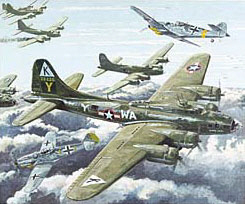
The U.S. 8th Air Force insisted on precision
daylight bombing as being most effective (as opposed to the British Royal Air Force which bombed
at night, targeting wide areas instead of pinpoint targets); however, that left the B-17
bombers at the mercy of the Luftwaffe for most of their journeys to and from the target,
as the Allies did not yet have fighter planes with a range to escort the bombers much
beyond the German border. Nonetheless, the planners felt that the "combat box" formations of the
heavily-armed B-17 "Flying Fortresses" would provide sufficient interlocking
firepower to defeat the German fighters.
Accordingly, Schweinfurt was attacked first on
17 August 1943. 230 B-17s left England, but the Luftwaffe had over 300 fighters available
to oppose them, and only 184 B-17s bombed Schweinfurt, and 36 did not return to England.
The firepower of the box formations had not been enough to defeat the Luftwaffe, and the
bomber crews suffered 341 casualties. Coupled with a loss of 24 bombers and 200 men from a
strike on Regensburg that same day, this was a heavy blow to the 8th Air Force. In
addition, reconnaissance indicated the Schweinfurt bombing was not as accurate as had been
hoped. The ball bearing factories had not been critically damaged.
|

|
"Bomber Raids on
Schweinfurt 1943" - Marshall Islands postage stamp |
"Attack on Schweinfurt"
- Antigua-Barbuda postage stamp |
After rebuilding its strength, the 8th Air
Force again attacked Schweinfurt on 14 October 1943, a day that would go down in history
as "Black Thursday." 291 B-17s left England, 229 bombed the target, and 60
bombers were lost. Crew casualties amounted to 639 men ... a loss the 8th Air
Force could not afford, and which put a halt, for the time being, to unescorted deep
strikes. The bombing was more accurate this time, but hindsight shows that it was not a
crippling blow to the bearing industry.
|

|
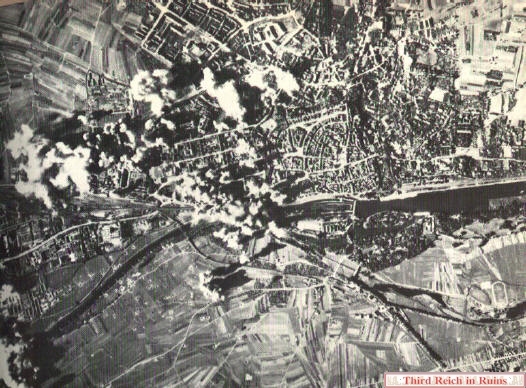
Bombs from the first wave of B-17s
falling on Schweinfurt on "Black Thursday." Bombs are hitting the Kugelfischer
and VKF-Werk I factories and the railroad marshalling yards just west of the downtown
area, but are also falling on residential areas north and west of downtown, and some bombs
are falling very wide of the mark south of the Main River and downriver to the southwest
(at the lower left corner). (U.S. National Archives, RG 342-FH-3A22431) |
Modern map of Schweinfurt at the
same scale and orientation, with the ball bearing factory areas outlined in red. The
factory closest to downtown (small one near the center of the map) was the VKF-Werk I. The large site
next to the left was the Kugelfischer-Georg-Schäfer complex, the largest in Schweinfurt.
South of the railroad yards, the smaller site was VKF-Werk II. At the left edge of the map
is the Fichtel & Sachs facility, with the small Deutsche Star factory inset at the
lower left. |
The 8th Air Force did not attack Schweinfurt
again until February 1944, by which time the Allies had long-range escort fighters and the
Luftwaffe was on the wane. In total, Schweinfurt was bombed 22 times by 2285 aircraft
during World War II, including attacks by the U.S. 8th and 15th Air
Forces, night bombing by the British Royal Air Force, and a final
tactical
attack by the 12th Air Force on
10 April 1945, the day before the U.S. Army took the city. A total of 7933 tons of bombs
were dropped on Schweinfurt (592,598 individual bombs), some 65% of the total dropped by the
Allies on all bearing
industry plants. However, after the "Black Thursday" strike, the bearing
industry was dispersed as much as practical, and it was no longer possible to cripple the
industry by concentrating on Schweinfurt. Post-war investigation by the U.S. Strategic
Bombing Survey showed that while production fell by early 1944 to about half of the
pre-attack totals, it rose again to about 85 percent by mid-1944. The German war machine
never suffered from a significant loss in bearing supply throughout the war. But
Schweinfurt was left largely in ruins ... half of the houses and four-fifths
of the industrial buildings destroyed, with 1079 civilian casualties.
 |
 |
| Bombing
Schweinfurt ... above - two views of the initial attack on 17 August
1943. At the left - B-17s drop incendiary bombs. At the right - the city and bearing factories
burn after the attack. Visible behind the B-17 at the upper right corner
of the photo are numerous smoke trails from smoke generating devices on
the ground near the Flugplatz military post, in an effort at
camouflage. Below left - the factory areas and city burn after the
"Black Thursday" attack of 14 October 1943. Below right - bombing attack of 24 February 1944, part of the renewed
bomber offensive called "Big Week." In the most devastating attacks of the war, Schweinfurt was hit three times in two days - on
24 February by the U.S. 8th Air Force, and on twice on the night of
24-25 February by the
British Royal Air Force. (USAF photos; above right - U.S. National
Archives, RG 342FH-3A22448; below left - U.S. National Archives RG
342FH-3A22445) |
 |
 |
 |
 |
| Bombers
lost and damaged during the attacks ... On the left above, a B-17 trails
smoke from its damaged No. 3 engine. On the right, B-17 #230831,
"Lazy Baby," of the 305th Bombardment Group, which was
shot down on 14 October 1943. Below - two that made it home, but with
heavy damage and crew casualties. On the left, B-17 #239789, "Skunk
Face," of the 379th Bombardment Group suffered tail and
stabilizer damage. The unidentified bomber on the right suffered
heavy damage to the nose. (below - True Magazine, April 1957) |
 |
 |
 |
 |
| The men
who bombed Schweinfurt ... On the left, the crew of the B-17
"Yank," which bombed Schweinfurt on 14 October 1943. On the
right, Col. Budd J. Peaslee, who led the attack on
Schweinfurt on 14 October 1943, in command of the First Bomb Division
(Mission 115 - "Black Thursday"). (left - Yank Magazine; right - True Magazine,
April 1957) |
-

In 1998 survivors of the bomber crews
who attacked Schweinfurt on "Black Thursday,"
14 October 1943, members of the Second Schweinfurt Memorial Association, and
members of the Flakhelfer anti-aircraft battery crews jointly
erected a monument
to the memory of the casualties on both sides during the bombing attacks on
Schweinfurt.
The monument is located at the side of the Spitalsee Luftschutzbunker.
These two links have detailed listings of bombers and
crew lost during the attacks on 17 August 1943 and 24 February 1944:
http://franckruffino.chez.com/My-Site/Victory_13.htm
http://franckruffino.chez.com/My-Site/Victory_21.htm
-
 |
 |
| The two bombing attacks
in 1943 scattered bombs widely over the town area, not just the factory
areas. By the time the bomber streams reached the aiming point, they had
been severely disrupted by Luftwaffe fighters and flak, and many bombers
simply released their bombs in the general area of the town. In the view
above left, taken on 17 August 1943, a string of bombs is falling along
Niederwerrnerstraße from the Panzer Kaserne into the
downtown area (nowhere near any bearing factories). The bombing of 14
October 1943 was more accurate, but still dropped bombs on the town
area, south of the river, and downriver away from the targets: above
right, the first wave falls on 14 October; below left, a subsequent wave
drops its bombs far to the west of the target area; below right,
incendiary bombs fall on the VKF-Werk I factory. (U.S. National
Archives, RG 342FH) |
 |
 |
 |
 |
| The
bombing attacks of 1944 were more accurate. Although some residential
parts of the city were still hit, the concentration of bombs fell in the
vicinity of the bearing factories. However, the RAF night attacks of
24-25
February 1944 caused widespread damage to the city. In the view at left
of the USAF attack on 24 February 1944, small streams of smoke can be
seen drifting across the Main River near the lower left corner of the
photo - these were an ineffectual attempt at smoke screen camouflage (see also
here). The view on the right shows the
bombing concentration on 13 April 1944. (left - author's
collection; right - U.S. National Archives RG 342FH-3A22452) |
 |
 |
| The
daylight bombing attack of 24 February 1944, observed from the Flak
Battery at Grafenrheinfeld, across the Main River southwest of the
city. On the left, bombs are striking the factory areas; later, the city
and factories burn after the attack. (author's collection) |
-
|

|
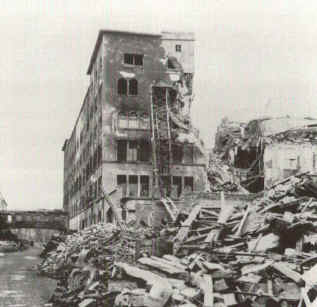
The main factory building of the
VKF-Werk I was heavily damaged. The building was repaired, and new
construction added on the near side. The company is now the world bearing supplier
SKF. (Note - this building was torn down in late 2006.) (Stadtarchiv Schweinfurt) |
 |
 |
| The
views above, taken looking from the other end of the street, show the
successive damage from multiple bombings to buildings near the VKF-Werk
I factory. All has been repaired in the modern view below (the
pedestrian bridge over the street was torn down after the war, and there
has recently been a shopping plaza built in this area). On the right
below is a view of the smoking ruins of the VKF1 building after an
attack. (Stadtarchiv Schweinfurt) |
 |
 |
-

|

|
The VKF-Werk II ball bearing
factory on Ernst-Sachs-Straße burns after one of the bombing attacks. In common with most of the 1940s
factory buildings, the VKF buildings were rebuilt after the war in
substantially their original forms. (Stadtarchiv Schweinfurt) |

Zwangsarbeiter (foreign workers)
clearing damaged milling machines in the VKF-Werk II factory after the
14 October 1943 bombing attack. (from SKF files, courtesy Jean-François
Soyez)

|

|
How the analysts of the U.S. Strategic
Bombing Survey found the VKF-Werk II
facility in April 1945. (U.S. National Archives - USSBS files, RG 342FH) |
 |
 |
-
 |
 |
 |
| The Kugelfischer
ball bearing factory burns after the 14 October 1943 attack. This side of the main building was
mostly destroyed by 1945 (center photo), but later rebuilt in its original form. The company is now FAG-Kugelfischer.
(Stadtarchiv
Schweinfurt) |

|

|

|
|
Following the October
1943 attack, the buildings of the Kugelfischer plant were disguised to mislead
aerial bomb damage assessment. On the left, the Hochgebäude was painted after
repair, to resemble dangling metal wreckage in the elevator shaft (this was in reality a
flat wall surface, with the elevator back in operation - this is the other side of the
building from that shown in the photos above). The
building on the right was painted to simulate damage to the bricks. (United
States Strategic Bombing Survey, Vol. 53) |
 |
 |
| Ruins of the
high-rise administration building of the Kugelfischer-George-Schäfer company, as seen by
the U.S. Strategic Bombing Survey team in 1945; and as the repaired building appears today. (National
Archives, RG 342FH- 3A22468) |

|

|
Administration buildings of the
Kugelfischer factory on fire on 14 October 1943. This scene has changed very little
today. (Stadtarchiv Schweinfurt) |

|

|
How the analysts of the U.S. Strategic
Bombing Survey found the Kugelfischer factory buildings in April 1945. By the end of the
war, many of the bearing factories were reduced to rubble, although
through dispersal of the bearing manufacturing capacity and blast walls
installed inside the factories, production was still estimated at 98
percent of pre-bombing totals in late 1944. (U.S. National Archives - USSBS files, RG 342FH) |
|

|
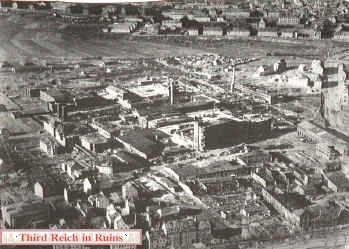
Ruins of the Kugelfischer plant in
1945. Most of the buildings show bomb damage, and some have been leveled. The
Panzerkaserne (now US Army Ledward Barracks)
is in the left distance, at the upper edge of this view. (Stadtarchiv
Schweinfurt) |
Modern aerial view from a slightly
different angle. Ledward Barracks is in the
center distance (white buildings with gray roofs, at the top edge). (FAG-Kugelfischer-Georg-Schäfer
AG) |
-

|

|
500-pound bombs cratered
Ernst-Sachs-Straße between the Fichtel & Sachs
factory (seen here) and the VKF-Werk II facilities. Today the company uses
the
name ZF-Sachs (a subsidiary of ZF Friedrichshafen AG). The building with the
pointed roof at the end of the street in the distance is the air raid
shelter A8. (Stadtarchiv Schweinfurt) |

|

|
Looking down Ernst-Sachs-Straße
in the opposite direction, at another large crater in the street. The Fichtel & Sachs
buildings are to the left. The rebuilt VKF-Werk II building
shown in the comparison above is on the right
in the modern view, with another VKF (now SKF) building just beyond it.
(from ZF-Sachs files, courtesy Jean-François Soyez) |
 |
 |
 |
| Left -
1936 view of the Fichtel & Sachs building; center - same view after a bombing attack in
1944; right - aerial view of the Sachs works in
1971. The VKF-Werk II building
(now SKF) appears in the lower left corner, across Ernst-Sachs-Straße from
the Sachs buildings. (left and center - Stadtarchiv Schweinfurt; right -
Elmar Hahn & Rainer Mehl, "Schweinfurt," 1971) |
 Continue to Schweinfurt, Part 2 --
bombing damage to the city itself
Continue to Schweinfurt, Part 2 --
bombing damage to the city itself
See also the subpage
on the Luftwaffe Munitions Depot at Rottershausen, north of Schweinfurt.
Click here for a list
of suggested readings on the battles for Schweinfurt.
"Reality - Remembering Schweinfurt" --
http://home.att.net/~ww2aircraft/Schweinfurt.html
Second Schweinfurt Memorial Association
-- http://home.comcast.net/~ssmahistorian/ssma.html
I wish to acknowledge the kind assistance of
the staff of the Stadtarchiv Schweinfurt provided during my photo research
there.
|


