|
Berlin
This page will feature only a few of the sites
associated with the capital of the Third Reich. Those wishing further information should
consult After the Battle's Berlin Then and Now, by Tony Le Tissier (London:
Battle of Britain Prints, 1997 edition).
Click
here for a MapQuest map link to Berlin.
Click here
to visit a page about the 1936 Berlin Olympics and the Olympic grounds today.
|
|
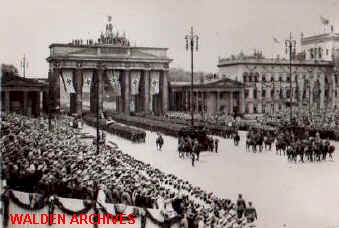
Victorious Wehrmacht soldiers
parade under the Brandenburg Gate and along Unter Den Linden, following the 1939 campaign
in Poland.
(author's collection) |
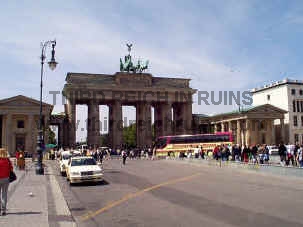
Similar view today. During the era
of the Berlin Wall,
this area was off limits in East Berlin. |
|

|
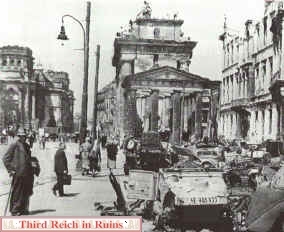
The
Brandenburg Gate was severely damaged during the war. Here is the scene in May 1945, with a wrecked SS Kubelwagen left
beside it. The same view on a busy summer day in 2000,
with the restored Reichstag building in the background. (Bundesarchiv Berlin) |
|

|
|
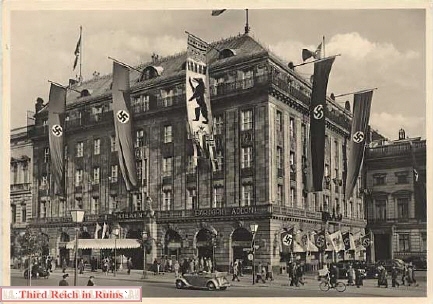
The famous Hotel Adlon near the
Brandenburg Gate is seen here decorated for Berlin's 700th anniversary
celebration in 1937. The hotel was recently remodeled and is again
Berlin's premier luxury accommodation. (period postcard) |

|

|
The Berlin Dom
(Cathedral) was also the scene of Nazi parades. In the photo on the left, a parade through
the Lustgarten in front of the Dom in 1933. The Dom was badly damaged by bombing during
the war, and was not rebuilt to match exactly the pre-war building. (from
"Deutschland erwacht - Werden, Kampf und Sieg der NSDAP,"
Hamburg, Cigaretten-Bilderdienst, 1933) |
 |
 |
 |
| More
period and comparison views of the Berlin Dom. On the left is an undated
Nazi gathering and on the right is a harvest festival similar to
Thanksgiving (Erntedankfest). (from Stanley McClatchie,
"Sieh: Das Herz Europas," Berlin, Hoffmann, 1937) |

The Berlin Christmas Market, with the
Cathedral in the background. (period postcard)
|

|
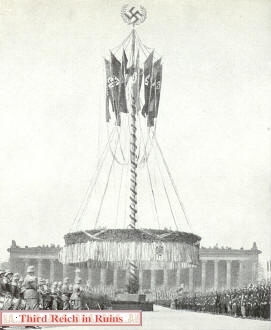
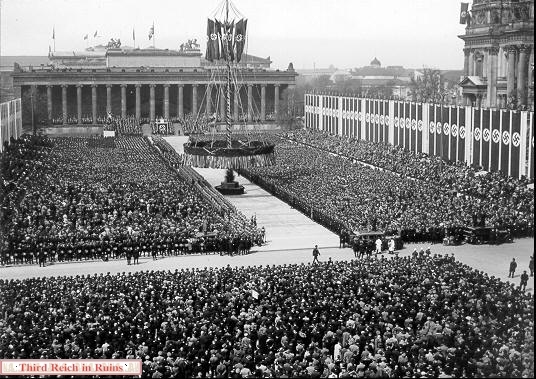
Adjacent
to the Dom is the Lustgarten, a large open area flanked by museums.
On the left and below can be seen the May Pole (Maibaum) with the Altes
Museum in the background, during a May Day celebration. (left - Hubert Schrade, "Bauten
des Dritten Reiches," Leipzig, 1937) |
|
|
|

|
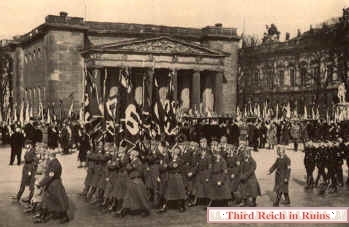
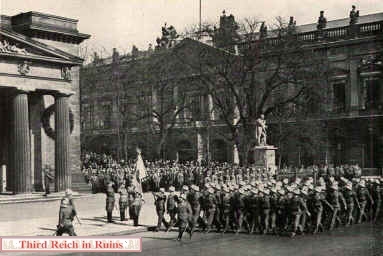
The Neue Wache (New
Guard) was originally a royal guard house erected in 1816. It became a war memorial in
1931, and was the focus of many parades down Unter den Linden during the Third Reich era.
The building to the right is the Zeughaus (Arsenal), which houses a history museum
today. (author's collection) |
 |
 |

|
|
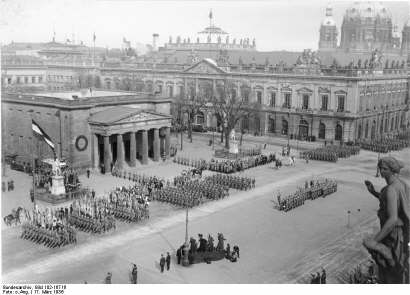
Left - Changing the guard at the Neue Wache,
from a 1936 postcard view. Right - Heroes Memorial Day in 1935. (left -
author's collection; right - Bundesarchiv) |
|

|
Two different armies
at the Neue Wache. On the left, Austrian soldiers parade following the Anschluß
of March 1938 (the Berlin Arsenal (Zeughaus) appears in the background). On the right,
East German honor guards keep watch in the 1980s. (photo on left from Gerd
Rühle, ed., "Das Dritte Reich," Berlin, 1938 ed. (author's collection); photo
on right courtesy R. Fogt). |

|

|
| On the left is
the ceremonial guard from the 1st Company of Hitler's bodyguard Leibstandarte at
the Neue Wache. (Hans Quassowski, ed., "Zwölf Jahre: 1.Kompanie SS
Adolf Hitler," Rosenheim, Deutsche Verlagsgesellschaft, 1989). For
another period photo of the Neue Wache, see http://www.silentwall.com/SceneryBuildings66.html. |

|

|
| The
Zeughaus (Arsenal) now houses the German Historical Museum (for more info
see http://www.dhm.de/ENGLISH/zeu_hist.html).
(Hans Quassowski, ed., "Zwölf Jahre: 1.Kompanie SS
Adolf Hitler," Rosenheim, Deutsche Verlagsgesellschaft, 1989) |
 |
 |
| German
Pzkw. I tanks parade down Unter den Linden during a visit by Admiral
Miklós Horthy, leader of Hungary, on 25 August 1938. The Neue Wache and
the Zeughaus can be seen in the right background. (Gerd Rühle,
ed., "Das Dritte Reich," Berlin, 1938 ed.) |
-
|

|
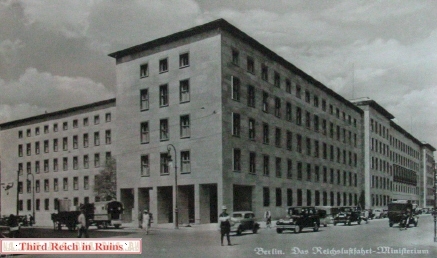
Reichsmarschall
Hermann Göring's Air Ministry building on Wilhelmstraße was a classic example of Nazi
architecture. The building somehow escaped major damage during the war, and was restored
by the East German government. Its appearance today is almost exactly as in the
1930s (minus the Eagles and Swastikas). (period postcard) |

Architectural model of the Air Ministry complex.
(from Official Catalog of the 1st German Architecture and Crafts
Exhibition, in the Haus der Deutschen Kunst in Munich,
January-March 1938 (author's collection)
 |
 |
| View of
the Luftfahrtsministerium at the corner of Wilhelmstraße and
Leipziger Straße. (from
Hubert Schrade, "Bauten des Dritten Reiches," Leipzig, 1937) |

|

|
|
The recessed entryway on Wilhelmstraße seen in the photos above figured in the funeral service for
Luftwaffe ace Werner
Mölders, who had died in an air crash in November
1941. Seen in the center of this photo are, left to right - Martin
Bormann, Julius Schaub, Adolf Hitler, Dr. Karl Brandt, and Field Marshall
Erhard Milch. (period photo) |

|
|
The ornate Ehrensaal, or
Honor Hall, of the Air Ministry. (from "Kunst in Deutschen Reich") |
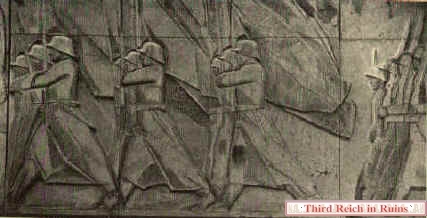
Other decorative sculptures in the
Air Ministry Building were by Arnold Waldschmidt. (from Werner Rittich,
"Architektur und Bauplastik der Gegenwart," Berlin, 1938) |
 |
 |
| Above -
building the Luftfahrtsministerium in 1935, and a completed
view. Below - views of the courtyard, showing some of the relief
carvings that are now covered over. (Bundesarchiv) |
 |
 |
-
 |
 |
|
Göring owned a nearby luxury villa near Leipziger Platz. All the
remains today is part of a low wall on the property. (photos
courtesy Mark Grootendorst) |
 |
 |

|

|
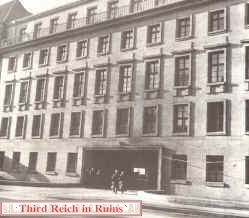
Joseph Goebbels'
Ministry of Propaganda stood prominently on Wilhelmstraße, across the street from the old
Reichs Chancellery. During building construction just before the fall of the Berlin Wall
in 1989, a dreary East German building was erected in the open area just on
Wilhelmstraße, blocking the front of the old Ministry building. This modern building is
today a youth activities building, and access to the old Propaganda Ministry building
behind it can be difficult. However, the entrance shown here was on
Mauerstraße. (from Frau Prof. Gerdy Troost,
"Das Bauen in Neuen Reich," Bayreuth, 1938) |
-
|

|
Wehrmacht headquarters on
Bendlerstraße was where Army officers who opposed Hitler
planned the attempt on his life on 20 July 1944. After the attempt failed, the leaders
were rounded up and shot in the courtyard of this building; among these was Col. Claus von
Stauffenberg, who had planted the bomb. Today the building houses the
Memorial and Museum of the German Resistance. The street has been renamed
Stauffenbergstraße. (Gedenkstätte Deutscher Widerstand) |

|

|
Left -
an SA column marches past the Anhalter Bahnhof (train station). The
station was severely
damaged by bombing during the war, and the ruins were pulled down in the 1960s, leaving
only part of the front façade. (Anhalter Bunker Museum) |
|

|
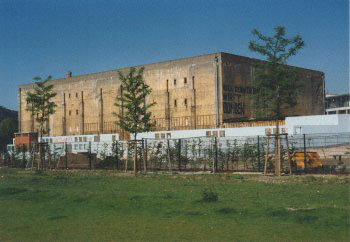
The Anhalter Bahnhof air-raid
shelter, seen from the side closest to the Bahnhof. The air-raid
shelter serves today as a haunted house and bunker museum. (My advice if you visit -
skip the "haunted house," and proceed directly to the bunker museum on the lower floor.)
(Anhalter Bunker Museum) |
-

|

|
Horst Wessel was a
member of the SA who was murdered by Communists in 1930. Propaganda Minister Joseph
Goebbels turned him into a Nazi martyr and hero, and Wessel's song "Die Fahne
Hoch!" became the favorite Nazi marching song. After the Nazi takeover of the
government in 1933, Bülowplatz was renamed Horst Wessel Platz, and the Communists were
thrown out of their headquarters at the Karl Liebknecht Haus, which became SA headquarters
and a shrine to Horst Wessel. (Click here to see the site
of Wessel's grave in the nearby Nikolaifriedhof cemetery.) (period photo
from
Imre Lazar, "Der Fall Horst Wessel," Stuttgart, 1980) |
|

|

|
| The
Gasthaus Zum Nußbaum was a popular inn that figured prominently in an
episode during the political battle for Berlin in 1929, when Horst
Wessel and his SA Troop ventured into the heart of the Communist
stronghold of the Fischerkietz district. Here, at the Zum Nußbaum,
Wessel faced down a crowd of Communist supporters and proclaimed the
area free of the "Red Menace," all without any bloodshed. This
part of Berlin was practically destroyed by bombing in 1943-45, but the
popular Zum Nußbaum was rebuilt as a copy in the mid-1980s in the
nearby Nikolai section, adjacent to the famous Nikolai Church, where
Horst's father Ludwig had served as pastor. (period photo from
Erwin Reitmann, "Horst Wessel - Leben und Sterben," Potsdam,
1933) |
-
|

|

|
| Horst
Wessel was born in Bielefeld in northwestern Germany on 9 October 1907,
in an apartment house on what was then Kaiserstraße. In 1939 a large
bronze monument was erected on a median in the middle of Kaiserstraße,
approximately in front of the Wessel birth house. The building directly
behind the statue, which is the building to the right in the monument
dedication photo on the left above, has been replaced. However, the
building to the left (behind the statue in the photo on the left above)
still exists, and still has the flagpole holders and iron hooks to hold
the wreaths between the windows and the long swastika banner running
down the middle of the building, that can be seen in the period photo.
In fact, this building, whose address is now Alfred-Bozi-Straße 14 (or
Oberntorwall 14), is practically unchanged from 1939, and is evidently
the original Horst Wessel birth house. (Google
Maps link) |
 |
 |
-

|

|
Inside the upper level of the Humbolthain Flakturm 3, just below the gun
platforms. This part of the ruined structure can be visited during a tour
by the Berlin Unterwelten group. |
|

|
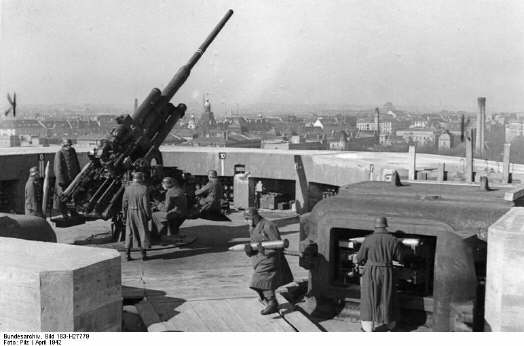
On the left, gun crews load one of the 12.8cm guns in a Berlin flak tower.
Ammunition was lifted to the gun platform on the top of the tower by a
hoist (seen in the right foreground), and carried by hand to the guns from
there. The guns had automatic rammer mechanisms to load the cartridges
into the breech. On the right is one of the smaller gun positions on the Friedrichshain
tower (Flakturm 2) - a Flakvierling four-barrel 2.0cm gun, for
engaging low-flying aircraft. The photos below show a 2.0cm Flakvierling
position on Flakturm 1 ("Zoo Tower"). (Bundesarchiv) |
 |
 |
 |
 |
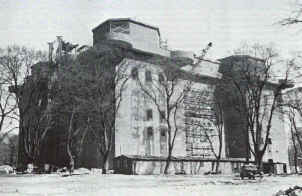
| Flakturm
2 was located in Friedrichshain Park. Following
the war it was mostly destroyed and buried in rubble from the bombed
city. Today only a small part of one of the upper parapets can be seen
above the current ground level. (Bundesarchiv Berlin) (MapQuest
Map Link) |
 |
 |
Click here to visit a page with more info and
photos of the Berlin flak towers (in German).
Click here to see the flak towers in Vienna.
|
|
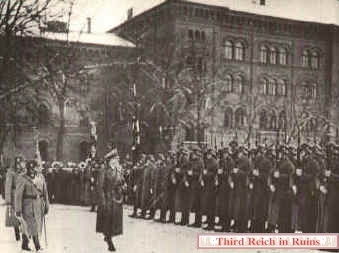
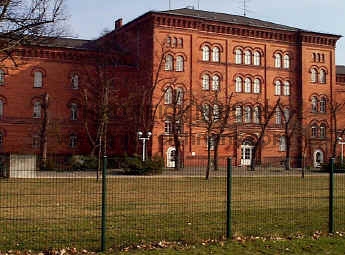
Lichterfelde Kaserne, southwest of
the downtown area, was an old Prussian cadet training school. The Nazis took it over in
1933, and it became the headquarters of Hitler's body guard regiment, the Leibstandarte-SS
"Adolf Hitler." In this December 1935 photo, Hitler and LSSAH commander Sepp
Dietrich review the Leibstandarte. The U.S. Army took the compound
over in 1945, and it served the Berlin Brigade as Andrews Barracks until 1993, when it was
returned to the German government. The older part of the barracks area seems mostly
deserted now. (National Archives, RG 242-HB) |
|

|
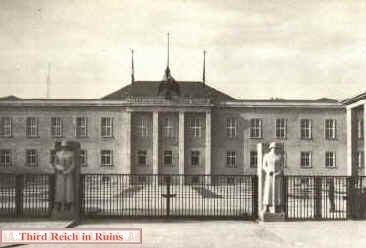
Other buildings on the
Kaserne were built in the 1930s especially for the Leibstandarte. This was their
headquarters building, with their name above the main entrance. The two stone guards, or
"Reichsrottenführer," stood eternal watch. The newer part of the compound is
now a German government archives. The Soviets removed the eagle and swastika before the
Americans arrived, and the US troops removed the Leibstandarte name. The
"Reichsrottenführer" guards were not removed, but covered with concrete; they
remain today on their pedestals, although hidden from view. (Wenn alle Brüder schweigen,
1981 ed.) (MapQuest
Map Link) |
Click here
to view other period images of the LSSAH Lichterfelde Barracks.
 |
 |
| Adolf
Hitler had plans to completely rebuild Berlin. Few of these
architectural plans were realized, but one that saw work was the
Fehrbelliner Platz. This was a series of office buildings in a
semi-circle around an open area, featuring decorative sculptures by
Werner March. Most of these decorative works are now gone, but some
remain. (Werner Rittich, "Architektur und
Bauplastik der Gegenwart," Berlin, 1938) (MapQuest
Map Link) |
 |
 |
 |
 |
| Hitler's
grand scheme was to redesign Berlin into "Germania," which
would be the capital of a Germanized Europe following a successful World
War II. These grand plans included a huge triumphal arch and an immense
domed building, with new government buildings along redesigned
North-South and East-West Axis boulevards. Almost none of this work was
started, but one project can still be seen above-ground (some tunnels
beneath the Tiergarten also remain from the "Germania" plans).
The structure seen above was placed to test the ability of the sandy
Berlin soil to support the weight of the triumphal arch. It was a large
concrete mass with apparatus to test and measure its movement relative
to the ground level. It can be found today off Dudenstraße near
Tempelhof airport. (photos courtesy Jacqueline Wilson)
(MapQuest
Map Link) |

|
|

|
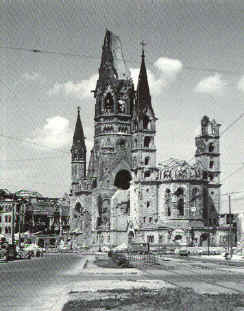
One of the most recognizable
sights in the western part of Berlin today is the spire of the Kaiser-Wilhelm
Gedächniskirche (Memorial Church). This view shows the church in the early 1900s.
The church was severely damaged
during the many bombing attacks on the city. The ruins of the spire and
transept
were left as a memorial to the
victims of World War II. (author's
collection) |

|

|
Berlin
hosted the 1936 Olympic Games, a propaganda coup for Adolf Hitler. The view
of the stadium remains much the same on the outside as it was in 1936, although the
curved swastika symbol has
been removed from the right-hand tower. The interior was completely
modernized for the 2006 soccer World Cup. (period photo from Werner Rittich,
"Architektur und Bauplastik der Gegenwart," Berlin, 1938) |
Click here
to view other period images of the Olympic and Reichsportsfeld area in Berlin.

|

|
|
Berlin was the scene of intense
building-to-building fighting, with tank battles and artillery barrages,
during the final days of World War II in late April and early May 1945.
Remaining German units were thrown in piecemeal to try to stem the tide of
the Soviet advances. On 29 April 1945, two King Tiger (Tiger II) tanks of
the 503rd SS Heavy Tank Battalion were stationed in Potsdamer Platz. Tank
Nr. 101 seen here was commanded by SS-Oberscharführer (E-6, equivalent to
U.S. Staff Sergeant) Karl-Heinz Turk. Turk's tank destroyed several Soviet
tanks over a three day period in the Potsdamer Platz. With damage to his
track and almost out of ammunition, Turk and his crew abandoned the tank
in front of the Potsdamer Bahnhof, where it was later photographed with
its turret turned toward the east.
This is an example of the
difficulty of matching many wartime photos to the current Berlin
locations. The Potsdamer Bahnhof was badly damaged during the war and
later torn down. Most of the other buildings on Potsdamer Platz were
demolished by the Soviets because the Berlin Wall ran right through the
center of the square. When the rebuilding of Berlin began in the 1990s,
building blocks and even entire streets in this area were changed from the
1945 configuration. Turk's Tiger tank sat in the foreground of the modern
photo, about where the line of cobblestones crosses the paved area (this
line of cobblestones marks the location of the Berlin Wall). The Potsdamer
Bahnhof was located in the near distance, just beyond the grassy mound. |

|
|
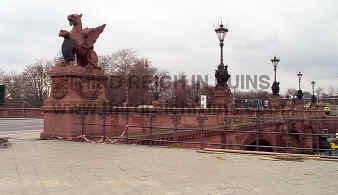
This photo is often labeled as
showing the famous Weidendammer Bridge, scene of one of the final tank actions of the war
on the night of 1-2 May 1945. However, it is actually the Moltke Bridge, some 1300 meters
to the west. As the Soviet tanks came onto the bridge from the north (other side of the
bridge in these photos), they could see their goal of the Reichstag building
straight ahead, only
600 meters away. (Bundesarchiv Berlin) An exact corresponding view is not
possible today, as the building from which the period photo was taken no longer exists,
necessitating a modern view from street level. This area remains under construction as
part of the new Berlin. (MapQuest
Map Link) |
-

|

|
The Reichstag
building had not been
restored by the Nazis since the 1933 fire that gutted the interior, but the Soviets
considered it a prime target in the battle for Berlin, and artillery and tank fire took
their toll on the building. In the foreground of the photo on the right
above is an 88mm Flak
gun. The Reichstag has been completely
restored, with a new glass dome, and the German government once again meets
there. (Bundesarchiv Koblenz) (MapQuest
Map Link) |
 |

|

|
Sans Souci, the
palace of Frederick the Great in Potsdam, was a favored spot for
visiting military units to get a group photo taken on the steps. On the
left, a group from the 1. Kompanie of the Leibstandarte-SS-Adolf-Hitler
poses in August 1942. On the right
is a Fallschirmjäger (Paratrooper) unit. (left - "Der
Freiwillige"; right - private collection) (MapQuest
Map Link) |
 |
 Continue to Part 2 of the Berlin page, featuring photos of the
location of Hitler's bunker, some of the burial sites of the Hitler remains (also Goebbels
and Bormann), and other area sites. Continue to Part 2 of the Berlin page, featuring photos of the
location of Hitler's bunker, some of the burial sites of the Hitler remains (also Goebbels
and Bormann), and other area sites.
Continue
to Part 3, other Berlin area sites - Grunewald RAD center, Tempelhof
airport, Humboldt University, Kummersdorf Proving Grounds, Zossen Bunker Site
Other Berlin pages on the Third Reich in Ruins
page:
Reichsportsfeld and site of the 1936 Olympic Games
Lichterfelde Barracks - home of the Leibstandarte SS
Bodyguards
Other Berlin web sites:
World War II in Berlin -- http://www.geocities.com/isanders_2000/ww2index.htm
Berlin Air-raid Shelters, Flak Towers and Bunkers --
http://www.geocities.com/lupinpooter/berlin.htm
Berliner Unterwelten e.V. (exploring Berlin underground)
-- http://www.berliner-unterwelten.de/
|