Geoff Walden
|
Geoff Walden
|
|
Underground Sites in Thüringen (Thuringia) As Allied bombing of the Reich resulted in increased destruction of critical factory areas and disruption in manufacture of Hitler's "Wonder Weapons," the Nazis began to move these and other critical sites underground. The state of Thüringen proved ideal, as it was located in central Germany (furthest from the advancing enemy forces) and had an abundance of deep wooded valleys and rugged terrain (difficult to invade), plus it had several tunnel mines already dug into hillsides, which only required enlarging to use as military facilities. One of the best known of these sites (of course, it only became generally known after the war) was the Mittelwerk near Nordhausen, where V-1 and V-2 rockets were made by slave laborers from concentration camps, deep inside a mountain factory. This site is covered on a separate page. This page shows three other sites in central Thüringen: an underground factory for the Me 262 jet aircraft near Kahla, a tunnel system that was started in the Elster valley at Berga, and an underground facility that may have been meant for the final Führerhauptquartier (FHQ) near Gotha. REIMAHG Me 262 Production Site near Kahla (Codename "Lachs" - "Salmon") One of the most remarkable advancements made by the German military in World War II was the production of turbine-jet aircraft. The most famous of these was the Messerschmitt Me 262, developed beginning in 1938 and fielded in 1944. A special production facility was started in 1944, for quicker assembly line manufacture. Due to the setup at the main Messerschmitt factories, fast assembly line production was not possible, and these sites were vulnerable to Allied bombing. Accordingly, a company called Flugzeugwerke Reichsmarschall Hermann Göring (REIMAHG for short) was formed as a subsidiary of the Gustloff Nazi industrial complex. REIMAHG eventually became concerned only with the Me 262, and its main production facility was located in an old sand mine for porcelain production in the Walpersberg Hill near Kahla (south of Jena) -- Codename "Lachs" ("Salmon"). The existing tunnels in the Walpersberg were enlarged and others were dug, and massive concrete bunkers were built outside these tunnels. Subparts were made and partially assembled in the tunnels, then moved outside to the concrete bunkers, where final assembly took place. The assembled jets were then moved to the top of the hill via a platform that moved along a railed ramp by a power winch. The top of the Walpersberg had been leveled off and concreted in a massive construction effort, to form a runway some 3300 feet long. This was not sufficient for an Me 262 to take off (even with the jet engines, take-off was actually fairly slow), so small rockets assisted take-off. The runway was also too short for the jets to land, so leaving the Walpersberg was an all-or-nothing proposition: there could be no emergency landings. The jets were flown from Kahla to a site some 130 kilometers away to be fitted with weapons and radios, and to undergo final testing. REIMAHG only managed to produce some twenty-seven Me 262 jet fighters by the end of the war. The work was done mostly by foreign forced laborers, some 991 of whom died during their nine months at "Lachs." The U.S. Army took the site on 12 April 1945, and before turning Thüringen over to the Soviets in July, they removed enough parts to finish five Me 262s that were found on the production line. Surprisingly, the Kahla area had not been bombed. British Intelligence had photographed Me 262s at the site in March 1945, so the Allies were well aware of "Lachs." But Kahla was spared the fate of the V-2 works at Nordhausen, which suffered a devastating bombing attack only eight days before the American Army arrived. (In spite of this historical report, the REIMAHG-Kahla site today shows many depressions that look very much like bomb craters that can be seen at such sites as Normandy and the Obersalzberg, and many areas that appear to have undergone explosive upheaval, all in areas that were flat during the war. This situation is apparently the result of Soviet activity after the war.) Beginning in 1947, the Soviets blew up the concrete bunkers and assembly buildings, and also the entrances to most of the tunnels, including destruction of the concrete runway on the hilltop. However, the concrete buildings had reinforced walls some 10 feet thick, so in many cases, the explosions only collapsed the roofs. REIMAHG-Kahla remains today one of the most extensive Third Reich ruins sites, with the walls and foundations of most of the concrete assembly and workshop buildings, some still supporting parts of their roofs. The site and bunker ruins can now be visited by the public - see www.reimahg.de. Click here for a Google Maps © map showing the location of this site.
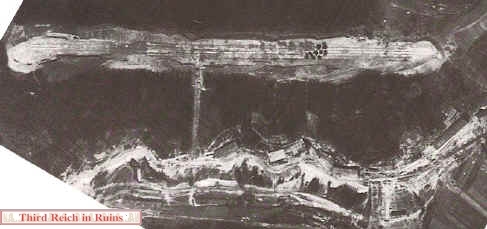
Part of an aerial view of the site, taken by British photo-reconnaissance on 19 March 1945. The Walpersberg with its hilltop runway is at the top. A tiny Me 262 can be seen just at the top of the ramp, beside the runway. Various bunkers and assembly buildings can be seen along the cleared area at the bottom of the slope, to the right of the ramp bottom. The dark blotches on the runway, to the right of the ramp, were an incomplete attempt at painted camouflage. (Combined Intelligence Objectives Sub-committee (CIOS) - Underground Factories in Central Germany, London, 1945)
Artist's concept of the site, based on the aerial photographs. The massive concrete bunkers can be seen along the bottom of the slope. The large buildings ran from east-west (right-left): Bunker 4, Hall 3, Bunker 1, Workshop 1, Bunker 0, Workshop 2, Bunker2. Just to the left of Bunker 2 was the bottom of the ramp for lifting the finished aircraft up the slope to the runway on top of the hill. (Note: This page uses the bunker numbering scheme shown in the 1945 CIOS Report, which differs somewhat from modern references.) (from Joan David, "Sky Spies," in Flying, Vol. 37 (1945), page 42)
Partial view of the REIMAHG site today, as seen from the southeast. The large concrete bunker seen on the right, above the village of Großeutersdorf, was Bunker 4. This long bunker can be seen near the right side of the site drawing above. Further remains can be seen to the left in this photo.
Klaus W. Müller and Willy Schilling, Deckname Lachs. Zella-Mehlis, Heinrich-Jung-Verlagsgesellschaft mbH, 3rd Ed., 1996. Joan David, "Sky Spies," Flying, Vol. 37 (December 1945), pp. 39-42, 106, 108, 111-112. Markus Gleichmann and Karl-Heinz Bock, Düsenjäger über dem Walpersberg. Zella-Mehlis, Heinrich-Jung-Verlagsgesellschaft mbH, 2009. For those that can find it, the best source of information in English on the Kahla REIMAHG facility is "Underground Factories in Central Germany," by the Combined Intelligence Objectives Sub-Committee (CIOS), London, 1945 (Item Nos. 4, 5, 25 & 30, File No. XXXII-17; copies in the U.S. National Archives and Imperial War Museum, London). NOTE - An association has been formed that manages a documentation center in Großeutersdorf and gives guided tours of the REIMAHG area. For further information, see www.walpersberg.com. Underground Fuel Production site at Berga/Elster (Codename "Schwalbe V") In late 1944 a hillside of slate boulders along the Elster river at Berga was chosen as the site of a tunnel system that was planned to produce fuel from coal. Laborers from the Buchenwald concentration camp and other locations were put to work excavating the tunnels under harsh conditions. These laborers included some 350 American soldiers who had been captured during the Battle of the Bulge and sent to the POW camp Stalag IX-B. In February 1945 a group of American POWs identified as Jews, or considered troublemakers or chosen because their names or faces seemed Jewish to the Germans, or simply chosen at random, were sent to work at the "Schwalbe V" ("Swallow") site. They helped excavate some 18 tunnels, but the tunnels had only reached a short distance when the war ended (there is disagreement over the total number of tunnels; some sources say there were only 17). Most of the prisoners were sent on a forced death march in early April 1945, and their camp was liberated on 23 April 1945. After the war the tunnel entrances were blown up or buried, except one. (Google Maps site location)
Some of the "Schwalbe V"
tunnel entrances can be seen along the hillside just above the Elster river in
this still
| ||||||||||||||||||||||||||||||||||||||||||||||||||||||||||||||||||||||||||||||||||||||||||||||||||||||||||||||||||||||||||||||||||||||||
|
Third Reich in Ruins, http://www.thirdreichruins.com/ All contents copyright © 2000-2021,
Geoffrey R. Walden; all rights reserved. All photos taken by or This page is intended for historical
research only, and no political or philosophical aims should be assumed. The appearance of hyperlinks does not constitute
endorsement by the author of the information, products or This page initially uploaded on 20 July 2000.
|