|
Munich / München
Part 1 -
Introduction
The Bavarian capital of Munich held a special place in the
Nazi pantheon ... it was the "Hauptstadt der Bewegung" -
the Capital of the Movement - the birthplace of the Nazi Party. Throughout the
Third Reich period, Munich remained the spiritual capital of the Nazi movement, with
headquarters buildings, museums to house the forms of artworks approved by Adolf
Hitler, and shrines to the attempted Nazi putsch in November
1923. These sites were used as the scenes of lavish annual memorial ceremonies,
and swearing-in ceremonies for new SS members. (MapQuest
map link to Munich)

The Munich coat of arms during the Third
Reich period. The traditional monk ("Münchnerkindl")
in front of the
city gate was joined by a Reichsadler with swastika.
This page is divided into six main
parts:
1. Introduction - foundation of the Nazi Party in
Munich, and sites associated with the early history of the Party and Adolf
Hitler in Munich (this page). Sites on this page include the Nazi Party offices
at the
Sterneckerbräu brewery, Cornelius Straße, Schellingstraße, and the Brown
House; Hofbräuhaus and Löwenbräu beer halls; Park Café, Schelling Salon,
Osteria Bavaria, and Café Heck; Hitler's residences at Schleissheimerstraße,
Thierschstraße, and Prinzregentenplatz; and Eva Braun's house in Bogenhausen.
2. The "Beer Hall Putsch" of November 1923
(Feldherrnhalle, Bürgerbräukeller site, Bavarian War
Ministry)
3. Nazi Party buildings on the Königsplatz (Führerbau, Ehrentempel, and
others)
4. Haus der Deutschen Kunst (art museum)
5. Other Third Reich buildings and sites in Munich, 1933-1945
6. Dachau Concentration Camp site
|
|

|
The
Deutscher Arbeiterpartei (DAP - German Workers Party) was founded in the
hotel Fürstenfelder Hof in Munich on 5 January 1919. When the Party
reorganized as the Nationalsozialistische Deutsche Arbeiter Partei
(NSDAP - National Socialist German Workers Party), it had offices in the
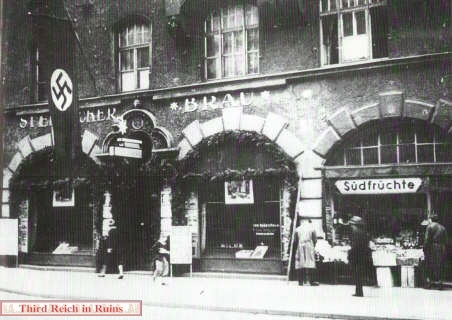
Sterneckerbräu brewery at Tal 54, near the city center (the address on the
street side is now
Tal 38 - currently a computer store). The Party had its offices here from 1 January 1920 until 31
October 1921. The official Party platform was formulated here on 24 February
1920, and Adolf Hitler (who had joined the previous autumn) outlined the Party program to the
public in the famous Hofbräuhaus
beer hall that same evening. (National
Archives, RG 242-HB) |
|

|

|
The
street address of Tal 54, and the entrance to the Nazi Party offices,
was actually on what is now Sterneckerstraße, a side street off Tal, seen in this 1920 view and as it
looks today (the street address on this side was recently changed from
54 to 38). (Heinrich Hoffmann, "Deutschland erwacht -
Werden, Kampf und Sieg der NSDAP," Hamburg, 1933) |
|

|

|
After the Nazi rise
to power, the
Sterneckerbräu office area was turned into a shrine and museum. On the left is the
location of Hitler's first office as Nazi Party leader. On the right,
Hitler visits the
Sterneckerbräu museum, along with Rudolf Hess, Julius Schreck, and
others. (period postcards) |
|
|

|
The
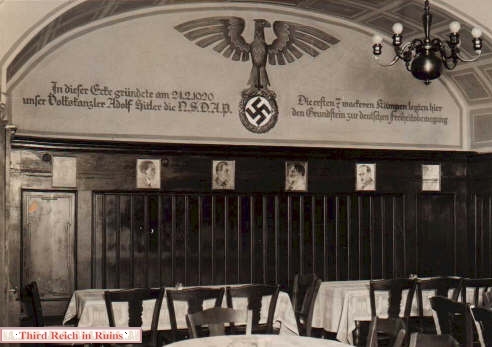
main Nazi shrine in the Sterneckerbräu was this corner, where the Nazi
party was founded in 1920. The wall originally displayed
portraits of the seven leaders who "laid the cornerstone for German
freedom" on 24 February 1920 (the original portraits included Goebbels, Göring,
Hitler, and Ritter von Epp). Later, the wall displayed eleven portraits
and a large painting of Hitler. (period postcards; right -
courtesy Helly Angel) |
|

|

|
This
room in the Sterneckerbräu was the Leiberzimmer, or veterans
hall, named for the Munich Leibregiment (Bodyguards). (left - Illustrierter Beobachter, Special Edition
"Adolf Hitler," 1936; right -
period postcard) |
 |
 |
| The Nazi
Party offices moved to Cornelius Straße 12 in November 1921, and the
Party offices were located here during the putsch
of November 1923. The modern building
façade has changed considerably since that time. (left - Heinrich Hoffmann,
"Hitler wie ihn keiner kennt" (Hitler as No-one Knows Him),
Berlin, 1932);
right - Illustrierter
Beobachter, Special Edition "Adolf Hitler," 1936) |
 |
|

|

|
In
July 1925 the Party moved to offices in the back of a building at
Schellingstraße 50. This building at one time housed the photographic
studio of Heinrich Hoffmann, official photographer of Hitler. The
entrance to the Party offices was in the rear courtyard (seen on the
right above). (Illustrierter Beobachter, Special Edition
"Adolf Hitler," 1936) |
|

|

|
Left
- the Honor Hall in the
Schellingstraße Nazi offices, ca. 1927. Right - Hitler conducts a meeting of the
Nazi leadership at
Schellingstraße 50 in 1928. The attendees at the front table included
Philip Bouhler, Arthur Ziegler, Alfred Rosenberg, Walter Buch, Franz X.
Schwarz, Hitler, Gregor Strasser, and Heinrich Himmler. Julius Streicher
rests his chin on his hands in front of the door. (left - Illustrierter Beobachter, Special Edition
"Adolf Hitler," 1936; right - Bundesarchiv) |
|

|

|
The
façade of
Schellingstraße 50 today still displays a headless eagle, the only
reminder of the Third Reich period. |
-

|

|
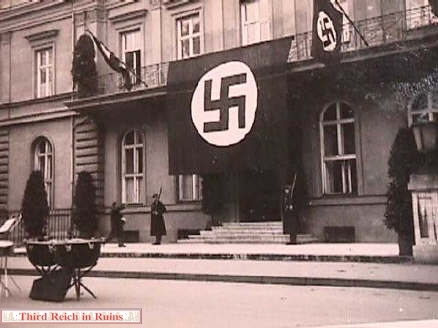
In
January 1931
the Party occupied new offices in the remodeled Barlow Palace on
Briennerstraße 45, near the Königsplatz. This came to be called simply the
"Braunes Haus." This section shows several views of the Brown
House, including the view on the right below which shows the Braunes Haus
(in the center background) in relation to the Ehrentempel and Führerbau
on the Königsplatz. The images at the bottom show the Braunes Haus
decorated on 15 October 1933 (left) and in 1935
(right). (Heinrich Hoffmann, "Deutschland erwacht -
Werden, Kampf und Sieg der NSDAP," Hamburg, 1933; Albert Reich,
"Aus Adolf Hitlers Heimat," Munich, 1933; U.S. National
Archives; "Der Staat der Arbeit und des Friedens,"
Altona-Behrenfeld, 1934; period postcards) |
 |
 |
 |
 |
 |
 |
| Views
inside the Braunes Haus. Above, Hitler at his desk in his office, and a
view showing the portrait of Frederick the Great on Hitler's wall. Below
left, a bust of Dietrich Eckart
and a plaque honoring the dead of the November 1923 putsch
attempt. On the right below is the flag display, with a statue of Otto
von Bismarck. The last reported location of the famous Blutfahne (Blood Flag
of the 1923 putsch) was in the Braunes Haus. ("Kampf um's
Dritte Reich," Altona-Behrenfeld, 1933; Heinrich Hoffmann, "Deutschland erwacht -
Werden, Kampf und Sieg der NSDAP," Hamburg, 1933) |
 |
 |
 |

|
|
On the left, another view of the
flag display. On the right, the Senatorensaal, or Senators Hall.
Nazi Party leadership was supposed to meet here, but in reality the hall
was rarely used. ("Kampf um's Dritte Reich,"
Altona-Behrenfeld, 1933) |
 |
|
|
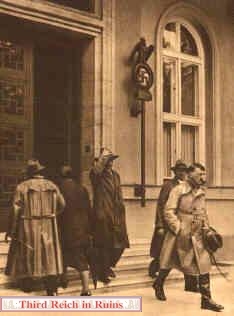
Hitler meets with SA men and other
admirers in the basement casino of the Braunes Haus. On the right, Hitler is seen leaving the Braunes
Haus - note the ornamental iron swastikas on the door. (left - "Deutschland
erwacht - Werden, Kampf und Sieg der NSDAP," Hamburg, 1933; right - Heinrich Hoffmann,
"Hitler wie ihn keiner kennt" (Hitler as No-one Knows Him), 1935) |

The
Braunes Haus was bombed and burned out in 1945. At the end of the war the
shell remained,
with one of the Ehrentempel
seen behind it in this view. (Munich City Museum)
 |

|
After the war the
Braunes Haus ruins
were razed, and the site was an empty lot adjacent to the Führerbau for many
years. In 2006 the basement was excavated, and several period relics
were discovered. There was talk of using the basement rooms as part of a
Documentation Center about Nazism in Munich, but the ruins were later
reburied. In 2011 this entire area was re-excavated and the basement
remains were removed for construction of the Documentation Center museum,
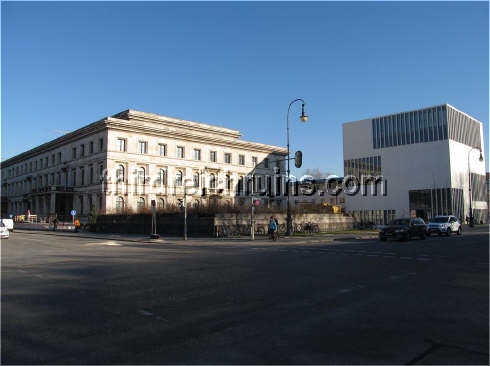
which opened in 2015. The view below shows the Documentation Center
(white cube) beside the Führerbau
and the base of the adjacent Ehrentempel,
on the site of the former Braunes Haus. |
|
|
-
|

|
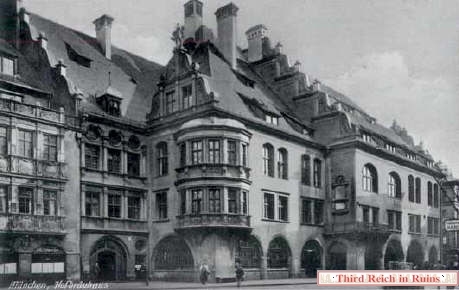
The world-famous Hofbräuhaus
beer hall, located at Platzl 9, was the scene of several Nazi meetings and some of Hitler's most memorable
speeches. (period postcard; modern photo courtesy Guy
Dartois) |
|

|

|
|
This plaque in the
Festsaal (Festival Hall) on the upper floor of the Hofbräuhaus commemorated Hitler's speech of 24 February 1920, in which he
laid out the goals of the new Nazi Party. The building was badly bombed during the war, and the
fire-damaged Festsaal was rebuilt somewhat
differently from its 1920s-1930s appearance, but the plaque was located
in the open area between these windows along the street side of the hall
(the right side, as you walk in). ("Ich kämpfe,"
Munich, 1943) |
 |
 |
| Hitler makes a commemorative speech
in the Festsaal on 24 February 1940 (?). The photo on the right appears to have been taken on the same date, although
it appeared in an English edition of Hitler's book Mein Kampf
that was published in 1939. Jakob Grimminger holds the Blutfahne
Blood Banner of the 1923 putsch, just behind Hitler's
podium. (above left - |
 |
Left -
Hitler and the "Old Fighters" meet in the Hofbräuhaus on 24
February 1929 to mark the anniversary of the famous speech. Left-right:
Gregor Strasser, Karl Fiehler (back to camera), Christian Weber, Hitler,
Julius Schaub (back to camera), Franz Schwarz, Max Amann. Standing in
the background, holding the Blutfahne, is Jakob Grimminger.
(Fritz Maier-Hartmann, "Dokumente der Zeitgeschichte," Vol. 1, 5th Ed., Munich,
1943) |
 |
 |
| Under new
management ... the Hofbräuhaus in April and May 1945. Above
left, the Hofbräuhaus was photographed by a U.S. Army Signal Corps
photographer on 30 April 1945, the day Hitler committed suicide in
Berlin. Above right - the entrance when the hall was used as a Command
Post (CP) for the 157th Infantry
Regiment of the 45th Division. Below, GIs from the 45th
Infantry Division tour the famous site. (above
left - U.S. National Archives, RG 111SC-207622; above right - 45th
Infantry Div. collection; below - Life Magazine, 14 May 1945) |
 |

|

|
|
The Löwenbräukeller (left),
located at Nymphenburger Straße 4, was another favorite location for early Nazi Party
meetings and speeches. The Park Café on Sophienstraße (right) was built
in 1935-1937 on the site of the former Munich
Glass Palace, which burned in 1931. The Park Café (built 1935) exhibited the
neo-classic style favored by the Nazis. |

|

|
|
Hitler frequented several Munich
restaurants, guest houses, and cafés, particularly in the late 1920s and
early 1930s, before security was an overriding issue. One of his earlier
haunts was the Schelling Salon (left, Schellingstraße 56), although it has been reported that
he stopped going there after the owner refused to extend his tab. Perhaps
Hitler's all-time favorite, which he continued to patronize even after the
beginning of World War II, was the Osteria Bavaria (right), located at the corner of Schellingstraße and
Schraudolfstraße, near
the Nazi Party offices . |

|

|
Changes
have been minimal, although the name is now Osteria Italiana, and it is
one of the best Italian restaurants in Munich. Above, Hitler visits the
Osteria Bavaria in 1940. Below, Hitler dines with a guest in the Osteria in
earlier times. Hitler's favorite seating areas were the back room on the
right (as you walk in), and a table facing the front windows. (above
- Bundesarchiv; below - U.S. National Archives, RG 242) |
 |
 |
 |
 |
 |
| During
the period 1913-1914, before he joined the Army for service in World
War I, Hitler lived in a furnished room at Schleissheimerstraße 34,
above what was then the Joseph Popp tailor shop. This was Hitler's
residence from 26 May 1913 until he joined the army in August 1914. At left
is an early view, and in the center is a Third Reich period view when
the building bore a commemorative plaque (I have read that this plaque
still exists, in the building's basement). Hitler's room was on the
upper floor, the room with the half-open window in the period views
above. The building façade has been
modernized, but the window and door layout is still easily recognizable.
(left- Bundesarchiv; center - Munich City Museum) |

|

|
After
returning to Munich following World War I, and subsequently leaving the
military, Hitler lived in a two room apartment at Thierschstraße 41, on
the first floor above the ground floor, from 1 May 1920 until 5 October
1929. The
building remains almost identical to when Hitler lived there. ("Wie
die Ostmark ihre Befreiung erlebte - Adolf Hitler und sein Weg zu Großdeutschland,"
Heinrich Hoffmann, 1938) |

|

|
In 1929
Hitler rented, and later purchased (largely with donated funds), a luxury apartment at Prinzregentenplatz
16 (eventually, the Nazi Party owned the entire building).
The apartment was furnished with furniture and decorations designed by
Gerdy Troost, widow of architect Paul Ludwig Troost. It was in this
apartment that Hitler's niece Geli Raubal,
whom some say was the only woman he ever loved, reportedly committed suicide in 1931.
Hitler's apartment was on the second floor above the ground level (third
floor, in American usage). This floor now houses the regional Police
headquarters, and is not open to the public. (above - Life Magazine, 28
May 1945; below - Munich City Museum) |
|

|

|
 |
 |
| Hitler
waves to admirers in Prinzregentenplatz from one of the windows at the
front of the apartment. (U.S. National Archives, RG242) |
|

|

|
| On the
left, Hitler's office area in his Prinzregentenplatz apartment, after the
American occupation in May 1945. On the right, the janitor Herr
Schissler and his wife. (Life Magazine, 28 May 1945)
|
 |
 |
| This
bathtub, which is now stored in
a basement room of the Führerbau,
is thought to be Hitler's tub from his Prinzregentenplatz apartment.
The famous photo on the right shows war correspondent and photographer
Lee Miller enjoying a bath in this tub in liberated Munich on 30 April
1945, the day Hitler committed
suicide in Berlin. (Another theory is that this tub came from a
washroom in the Führerbau that Hitler used.) (Lee Miller Archives) |
 |
 |
 |
| An air
raid shelter with reinforced walls and metal bunker doors was installed
in the basement of Hitler's apartment building. |
 |
 |
Hitler's
mistress Eva Braun was provided with a small house in the fashionable
Bogenhausen district, not too far from Hitler's Prinzregentenplatz
apartment. During the Third Reich period the street address was
Wasserburgerstraße 12, now it is Delpstraße 12. Eva's younger sister Gretl
also lived in the house. This house served as their primary residence
when Hitler was at the front during the war, or otherwise not living in
his home on the Obersalzberg.
The period views seen here show the back of the house, which is not
visible from the street. Foliage obscures much of the house view
today. (above - from Eva Braun's photo albums in the U.S.
National Archives, RG242EB-2-11A; below - (Life Magazine, 28 May 1945)
Note - Eva Braun's house was torn down by a real estate
developer in November 2015. Thanks to Steve Whitehorn
for this info and the photos at bottom.
|

| 
|

| 
|
 |
 |
|
On the left, Eva Braun's living room,
after the American occupation. On the right is the bedroom of Eva's sister
Gretl, complete with framed portrait of Eva and signed portrait of
Hitler. (Life Magazine, 28
May 1945)
|
 Continue
to Part 2, the Beer Hall Putsch of 1923 Continue
to Part 2, the Beer Hall Putsch of 1923
 Back to the Third Reich in Ruins homepage
|


