|
Garmisch-Partenkirchen
In order to show off the growth and strength of
his new Reich, Adolf Hitler pulled out all the stops for the 1936 Olympic Games to be held in
Germany (the location had already been decided before Hitler became Chancellor in 1933).
The summer Olympics were held in Berlin, but first, in February, the IV. Winter Games were
held in the Bavarian alpine venue of Garmisch-Partenkirchen. An Olympic ice stadium was
built in Garmisch, and a ski stadium was built in its sister village of Partenkirchen (the
two municipalities are on either side of the Partnach River), in the shadow of Germany's
highest mountain, the Zugspitze. Both stadiums are still in use today.
(MapQuest
Map Link)
The Garmisch area was also the
location of two tunnel systems used to manufacture aircraft in
the final months of World War II - click here to see
photos of these sites.

|

|
|
The Kunsteisstadion (on the
left) was the venue for the ice skating, hockey, and speed skating events.
The Festhalle or Festsaalbau (on the right) was built to
support the Olympic festivities. The Ice Stadium field was covered over in
1962, and the Fest Hall was torn down several years ago. (Bundesarchiv) |

|

|
|
The Olympic Ski Stadium was built
for up to 100,000 spectators. In the center, directly in front of the ski
jumps, was the Olympiahaus, with a restaurant and VIP viewing area.
The stadium exists today much as it was in 1936. |

|

|
|
Hitler viewed the 1936 Olympic ski
jump events from his special covered area on the balcony of the Olympiahaus.
Seen at far left above are Dr. Wilhelm Frick and Dr. Robert Ley. These
scenes were all from the opening ceremony on 6 February 1936. (above
- "Olympia"
cigarette-card album, 1936; below - Bundesarchiv)
|

|

|

|

|
|
Hitler leaves the main entrance of
the Olympiahaus. The Olympic Rings and building name still appear
above the doorway. (Bundesarchiv)
|

|

|

|
|
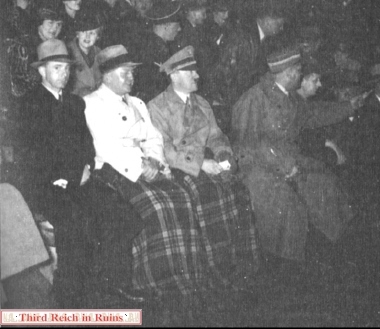
Left -
the 1936 Winter Games are declared open by Dr. Karl Ritter von Halt,
president of the Winter Olympics Committee. Right - Hitler and entourage
view the Olympic events. Seated with Hitler on the front row are Press
Chief Otto Dietrich, Gauleiter Adolf Wagner, and adjutant Wilhelm
Brückner (facing away). Note also Eva Braun in the row behind, sitting
next to Sofie Stork. ("Olympia"
cigarette-card album, 1936) |

|

|
Above -
Hitler's
viewpoint toward the ski jumps, and a view from a period postcard - note
the swastika design in the grass of the longer jump. Below - my father took an almost identical view
in the winter of 1945-46, and the view has changed very little
today. 2007 note - The existing ski jump, some of which was rebuilt
in the 1950s, was torn down in April 2007 to allow a new jump to be
built that would comply with current European standards. So this view is
somewhat different now. (above - "Olympia"
cigarette-card album, 1936; below - collection of G.R. and G.A. Walden) |
 |
 |

|

|
View of the ski stadium entrance
and grandstands, taken in winter 1945-46 by my father, Army Air Forces Lt. Delbert R. Walden.
The view today has hardly changed
at all. Only the U.S. Third Army signs above the entrance reliefs are missing.
(collection of G.R. and G.A. Walden) (MapQuest
Map Link) |

|

|
The Olympiahaus
in the center was flanked by the two main entrances for the spectators,
featuring large sculptures of a woman holding a falcon or eagle, a flag
bearer, torch bearer, and a woman holding a victors wreath. |

|

|
On the
outside of the entrances was the 5-ring Olympics symbol. Flagpoles ringed
the stadium grandstands. |

|

|
The
Garmisch-Partenkirchen Rathaus (city hall) was built in 1935 by
Oswald Bieber, with sculptures and painted decorations by noted artist
Josef Wackerle. |

|

|
On the
left is a postcard view showing the Garmisch post office decorated with a
Nazi sign over the street. |

|

|
One of
the central areas in the town of Garmisch was named Adolf Wagner Platz
after the Gauleiter of München-Oberbayern (today's Marienplatz). The
views below show the Haus der Nationalsozialisten on Adolf Wagner
Platz, the Nazi headquarters in Garmisch-Partenkirchen. (Bundesarchiv) |
 |
 |
-

|

|
|
On the left is the Garmisch
Standort Lazarett, or garrison hospital. The photo on the right shows the
U.S. Army Abrams Hotel in the 1970s (building at the left in the period
photo). The hotel was closed in 2007 and the complex is used today to
house refugees (see also here).
(left
- Frau Prof. Gerdy Troost, "Das Bauen im Neuen Reich," Vol. 2,
Bayreuth, 1943; right - courtesy Gerald Stephenson; 2010 info courtesy
Robert Newton) |
 |
 |

Another remainder of the period that
could be
seen in Garmisch is this wall mural in a stairwell of the U.S. Army Post Exchange (PX)
building (actually in Partenkirchen). Garmisch was the headquarters of the German
Gebirgstruppen (Mountain Troops), and the Americans took over their military facilities in
1945. (Note - This post has now been closed, and this building has been torn
down - thanks to Tim Heck and John Mann for this news.)
Olympia
Tunnel at Eschenlohe
In preparation for the 1936 Olympics,
two road tunnels were driven through the Vestbühl hill at Eschenlohe for
highway B2, the main highway going south into Garmisch-Partenkirchen. In March
1944 these tunnels were closed to traffic and used as an underground factory
site to build parts for the Messerschmidt Me-109 fighters and Me-262 jet
aircraft. Parts assembly was done in workshops inside the northern tunnel and
barracks buildings were also set up in the area between the two tunnels. This
underground factory site operated under the codename "Ente" (Duck).

|

|
The
southern entrance to the northern tunnel is seen here in the summer of
1945 (looking north). Auxiliary tunnels, largely of unfinished bare rock,
were drilled beside both main road tunnels. Most of these tunnels are
sealed today (left below). The northern entrance to the main road tunnel
(right below) retains more of its original concrete face.
(above -
courtesy Ray and Gilda Northcott) (Google
Maps link) |
 |
 |

|

|
The
tunnel interiors preserve their period appearance. The northern road
tunnel had a series of large work chambers built into the side. These side
chambers were added in 1944 as the main work area for Messerschmidt
aircraft parts construction. The entrances to
this two-story work area can be seen on the right below (the lower
entrances, at the road level, are blocked today). |
 |
 |

|

|
These
photos show the top of the northern road tunnel and the large concrete
structure at the northern end. The small bunker-like structure below (of
unknown purpose) sits on the concrete tunnel roof. |
 |
 |
 |
 |
 |
| The
northern entrance to the southern road tunnel has a "false"
front that is detached from the hillside behind (center). This tunnel also has an
auxiliary tunnel bored into the rock beside the main road tunnel. |
Messerschmidt
Test Facility Tunnels at Oberammergau

|

|
Adjacent
to the Mountain Troops post in Oberammergau (today's NATO School) was a
small tunnel system built in 1944 for Messerschmidt company development
and testing of advance aircraft designs, as well as production of the
Me-262 and P.1101 jet aircraft. The code name of the tunnel system was
"Cerusit." Six tunnel entrances led to eight tunnels with two
cross tunnels. After the war, all tunnel entrances were collapsed and/or
sealed with concrete. Below are the two main entrances, sealed with
concrete today. (Google
Maps link) |
 |
 |
 Back to the Third Reich in Ruins homepage
|



