|
End of the War in the
Main-Spessart Region
When the American forces crossed
the Main River near Aschaffenburg in late March 1945, there was still active resistance
from several German units in the area. These units fought a retreating action to the east
in early April, to a general line running from Würzburg in the south to
Bad Kissingen in
the north. Several German towns and villages were severely damaged in the process, and
casualties were high on both sides. (All period photos in this section from U.S. Army
sources, except where noted)

|

|
The
town of Lohr suffered the effects of heavy fighting on 2-3 April 1945. The defenders,
including SS sharpshooters, Sturmgeschütz self-propelled guns, and teenage Hitler Jugend
boys armed with panzerfausts, knocked out eight Sherman tanks of Combat Command B, 14th
U.S. Armored Division (47th Medium Tank Battalion), seen here on the Hauptstraße (Main
Street). The infantry seen here were from the 19th Armored Infantry
Battalion. (National
Archives, RG 111-SC) |

|

|
A
closer view of the knocked-out M4A3 Sherman tank that can be seen in the center distance
in the previous photo. This tank was shot by a 15-year-old Hitler Jugend member with a
panzerfaust, wounding the driver, who lost control. The tank made an abrupt turn and
crashed into the store front of Hauptstraße 43, the butcher shop of Franz Mayer. Notice
the sandbags placed around the hull and turret as extra armor (unsuccessful in this case).
Another knocked-out Sherman can be seen behind it to the left. Amazingly, this store is
still the Metzgerei Franz Mayer, hardly changed at all, allowing a perfect modern match.
(National Archives, RG 111-SC 203655) Click here
to see a Third Reich Forsthaus in Lohr. (MapQuest
Map Link) |

|

|
Tanks
of the 14th Armored Division advancing into the village of Langenprozelten along the Main
River, on 4 April 1945. Waffen-SS defenders destroyed one of the M5 light tanks in the
advance with a panzerfaust, and the village was then bombarded by American artillery and
fighter-bombers. (The knocked-out tank was from D Company, 47th Tank Battalion, tank
commander Sgt. Virgil Bardwell. Two of Bardwell's crew were killed in this action and
Bardwell himself was severely burned.) Post-war housing appears in the foreground, but the
two buildings next down the street remain the same. (Information on the actions
of the 14th Armored Division on this page are from "The History of the 14th Armored
Division," by Capt. Joseph Carter; Atlanta, Albert Love Enterprises,
1945; and "Combat History of 19th Armored Infantry Battalion,"
by Lt. Walter R. Dickson, Munich, 1945.) |
-

|

|
A
short distance upriver is the picturesque town of Gemünden,
famous for its three rivers and the ruins of Schereburg fortress. During fighting on 4-5
April 1945, Gemünden was practically destroyed. The bridge over the Fränkische Saale
River had been blown a week earlier, during the abortive American attempt to liberate the
Hammelburg POW camp
(Task Force Baum). One would not realize this
destruction today - even the ruins of the castle were cleverly rebuilt. Note the Sherman
tank at the left of the photo - this is the same tank seen in the photo below.
(National Archives, RG 111-SC 204107, courtesy Digital
History Archive) (MapQuest
Map Link) |

|

|
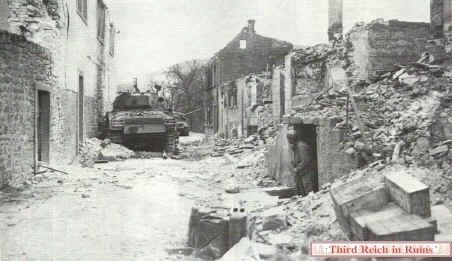
The
part of town on the west bank of the Sinn River is known as Kleingemünden. This part of
town suffered particularly heavily, as it was fought over twice, the first time being when
Task Force Baum was diverted here by blown
bridges. The M4A3E8 tank in this photo is one of TF Baum's tanks that was immobilized near
the western side of the Saale River bridge (LT Raymond Keil, C Co., 37th Tank Battalion).
The infantrymen seen here were from the 19th Armored Infantry Battalion, Combat Command B, 14th
Armored Division. This part of town was greatly changed during the post-war
reconstruction. (National Archives, RG 111-SC 204108, courtesy Digital
History Archive) |
Keil's tank is also shown in this photo (in the
distance, gun tube pointing to
the upper right),
as is a second Sherman tank of Task Force Baum that was knocked
out here on 27 March 1945.
A modern comparison shot is meaningless,
because the building layout here was changed
during the reconstruction. (National Archives, RG 111-SC)

|

|
GIs of the 62nd Armored
Infantry Battalion, 14th Armored Division, fight their way
through the ruins of Gemünden. This photo was taken by an Army Signal Corps
photographer on 6 April
1945. This scene has changed very little (except the street has been
widened - the building on the left is no longer there). (National Archives, RG
111-SC 204110, courtesy Digital
History Archive) |

|

|
An
M8 Greyhound armored car of the 14th Armored Division moves past flaming
buildings toward the main square of Gemünden. Note how the destroyed
buildings were rebuilt in the 1950s. (National Archives, RG
111-SC-203829) |

|

|
As
GIs of the 62nd Armored Infantry, 14th Armored Division, make their way
through the ruins of Gemünden (left), Red Cross "donut dollies"
hand out their specialty to 14th AD tankers on the outskirts of town. Both
of these photos were taken by Army Signal Corps photographers on 6 April
1945. (National Archives, RG 111-SC-204109, 204114, courtesy Digital
History Archive) |

|
|
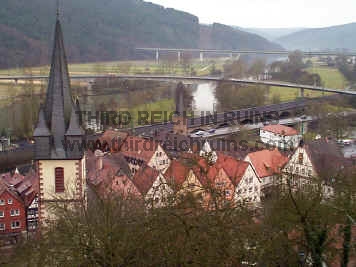
A
graphic look at the destruction that many fought-over German towns suffered. This is
Gemünden in April 1945. American artillery, tank fire, and fighter-bomber attacks left
the town in rubble. In the 1945 view, taken from the ruins of the Schereburg fortress, the
remains of the spire of the St. Peter and Paul Church can be seen at the lower left
corner. The ornate 16th century Rathaus (town hall) is part of the rubble at the lower
right. One of the towers of the medieval town wall appears as a lonely sentinel
overlooking the railroad bridge beyond, which had been blown by the defenders. The modern
view from the same area shows the wonders of post-war rebuilding. Only the Rathaus was not
rebuilt. (Stadtarchiv Gemünden am Main) |
|

|

|
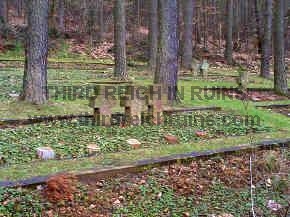
| Many of the victims of
the fighting around Gemünden, including some 120 civilian casualties, are buried in the
"Einmal" War Cemetery on the Burgsinn road. Of the civilian dead, the oldest was
a 90-year-old grandmother, and the youngest was a 5-month-old girl. Many of the individual
soldier markers say only "Ein Unbekannte Soldat" (An Unknown Soldier). The
cemetery chapel includes memorials to St. Sebastian and St. Martin, the protector of
soldiers. |
|

|
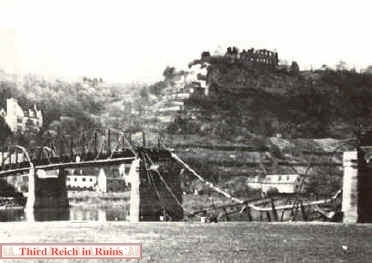
Karlstadt
is the next town upriver from Gemünden. The town was bombarded with artillery from 3-6
April 1945, and troops of the U.S. 42nd Infantry Division entered the town on 7 April. The
bridge over the Main River had been blown on 27 March. A new bridge was built on the old
piers, but the ruins of the Karlsburg fortress still overwatch the town from
the hill beyond.
(MapQuest
Map Link) |
Task
Force Baum and Hammelburg

|

|
Adjacent
to the town of Hammelburg was a German military training area.
This area was best known for its POW camp, which the Americans tried to liberate in an
ill-conceived raid on 26-28 March 1945. The raid failed, and most of the participants
ended up as POWs themselves. Hammelburg was finally liberated by the 14th Armored Division
on 6 April. This picture shows Sherman tanks of the 47th Medium Tank Battalion breaking
through the wire of the POW camp during the final liberation (not during TF
Baum). (National
Archives, RG 111-SC) (Click here to visit Peter Domes' excellent page on the
Task Force Baum raid)
(Scroll down to see more photos of Hammelburg in the 1930s and 1940s)
(Google
Maps link) |

|

|
Soldiers
from the 14th Armored Division fire their M3 "Grease Gun"
submachineguns at a locked gate at the edge of the POW camp. This photo
was taken just back up the street from the photo above. (U.S.
National Archives, RG 111-SC; modern photo courtesy Tim Tracy) |

|

|
Two
original tanks knocked out during Task Force Baum still exist. One of
these was the Sherman tank called "Cobra King," the company
commander's tank of C Co., 37th Armored Battalion. This tank, a Sherman
"Jumbo" model, had become famous when it led the relief column
into Bastogne during the Battle of the Bulge. The tank was later modified
with a long 76mm gun, and it took part in Task Force Baum in this
configuration (seen on the left), commanded by 1LT William Nutto. The tank
was disabled near the Hammelburg camp, and was retained by the U.S. Army
after the war and put on display at Rose Barracks in Vilseck. Researchers
discovered that this display tank was the famous "Cobra King,"
and it was sent to the Patton Museum at Fort Knox, Kentucky, where it was
restored to its condition during the Battle of the Bulge (seen on the
right). The tank is now in storage at Fort Benning, Georgia, awaiting the
construction of a new armor museum. |

|

|
The
second Task Force Baum tank that still exists is this damaged Sherman
105mm self-propelled artillery tank. Three such tanks were attached to
Task Force Baum, under the command of T/Sgt. Charles Graham of the 10th
Armored Infantry. This tank, Graham's own, was knocked out by fire from a
German Hetzer tank destroyer during the final defeat of Task Force Baum.
The tank remained on the range area of the Hammelburg training grounds,
where it was used as a target for many years. In March 2013 the tank hulk
was recovered from the training area and placed in the Deutsch-Amerikanisches
Nachkriegsmuseum in Rütschenhausen, near Schweinfurt,
where it will be preserved and possibly restored. |
 |
 |

|

|
The
circled hole in the turret is believed to be the penetration of the Hetzer
round that knocked this tank out (the other marks in the armor are results
of the tank having been a range target at Hammelburg). The museum also
displays a tanker's helmet with a faded insignia from the 37th Armored
Battalion, found near the site of Task Force Baum's last stand at
Hammelburg. |

|

|
Two
memorials between Hammelburg and Schweinfurt commemorate casualties that occurred when the
U.S. Army moved through the area in early April 1945. The marker on the left, on the road
between Wülfershausen and Schwemmelsbach (west of Schweinfurt), shows the location of an
action on this site on 7 April 1945, in which three Wehrmacht soldiers of the
36th
Volksgrenadierdivision were killed during the advance of U.S. forces, parts of either
the 42nd Infantry Division or the 14th Armored Division. (One local story
says these soldiers were actually executed by the SS, for desertion. This
photo was taken on the 60th anniversary of this action, 7 April 2005. Thanks
to Ryan Meyer for additional info.)
The plaque on the right is in the village of
Greßthal (also west of Schweinfurt), which was part of a defensive line set up by an SS
officer on 6 April 1945. It marks an action in which German soldiers fired on the American
advance, reportedly killing a U.S. Army Major. Much of the village was destroyed during the ensuing
action, which took place the same day as the action in the photo to the left. The plaque
honors a local citizen who was killed. The U.S. troops who fought through here were from
the 19th and 62nd Armored Infantry Battalions and the 25th Tank Battalion,
all of the 14th Armored Division, but I have been
unable to verify the story of the Major who was killed here. Unit records
mention fighting in
Greßthal, and heavier fighting just to the northeast in Wasserlosen, but
none mention any U.S. casualties. The fighting in Wasserlosen involved a
Sherman tank with German markings, apparently one of those that had been
captured earlier from Task Force
Baum (this tank was knocked out by the 47th Tank Battalion; the 25th
Tank Battalion apparently captured another Balkenkreuz-marked
Sherman intact). |
|

|

|
| GIs from
the 19th Armored Infantry Battalion pause on the outskirts of Greßthal
on 7 April 1945. They had moved through Wülfershausen to the southwest,
and were apparently waiting for armored support before moving on into
Greßthal, as they were under sporadic artillery fire. The comparison
photo was taken on the 60th anniversary, 7 April 2005. (National Archives, RG 111-SC-341769) (MapQuest
Map Link) |
|

|

|
| An M4
Sherman tank from the 47th Tank Battalion, 14th Armored Division moves
into action at Wasserlosen along the road from Greßthal on 7 April
1945. The edge of town has since moved past these houses, but they are
still there - the house at the left edge of the 1945 photo is the house
with the red roof at the left edge of the modern photo; across the
street is the identical Fachwerk (half-timbered) house; the large
house in the period photo has changed somewhat, but can still be
identified at the right-center of the modern view (red roof with two
chimneys). Smoke rises from the American artillery bombardment of the
main town area. This is the area where tankers from the 47th Tank
Battalion knocked out a Balkenkreuz-marked Sherman, which had
been captured in late March from Task Force
Baum. The comparison photo
was taken on 7 April 2005. (National Archives, RG 111-SC-336917;
courtesy Digital
History Archive) (MapQuest
Map Link) |
|

|

|
| The
following day (8 April 1945) the 19th Armored Infantry and the 47th Tank
Battalion of the 14th Armored Division passed through the village of
Hesselbach, northeast of Schweinfurt. (The white markings are crop marks
on the original photo.) (National Archives, RG 111-SC-335305,
courtesy Digital
History Archive) (MapQuest
Map Link) |
The
Battle for Steinach a.d. Saale
 |
 |
| During
the advance of the U.S. Army in the area north of Schweinfurt in early
April 1945, elements
of the 3rd Infantry Division and the 94th Cavalry Regiment of the 14th
Armored Division encountered enemy tanks in and around the village of
Steinach an der Saale (Fränkische Saale river), about 10 miles north of
Bad Kissingen. The 7th Infantry Regiment and 601st Tank Destroyer
Battalion of the 3rd Infantry Division reported fighting German Panther
tanks in Steinach in a battle that lasted through the night and into the
next day. During this battle, much of the village was reduced to ruins.
It is unclear whether the U.S. M36 tank destroyer seen above was
knocked out during the village fighting, or was simply parked in this
alley after the battle. (Stadtarchiv Steinach) (MapQuest Map
Link) |
 |
 |
| The
bridge over the Fränkische Saale river, between Steinach and Roth, was
destroyed during the fighting. From this photo taken from the modern
concrete bridge, the original mill buildings in the background can still
be seen. (Stadtarchiv Steinach) (MapQuest Map
Link) |
 |
 |
| The
knocked-out Panther tank on the left was found at Alt-Fuldisch in
Steinach (the area
looks completely different today). On the right is a plaque on the
church wall, detailing the damage to the village as a result of
artillery and direct fire from both sides - some 75 % of the village
buildings were destroyed or severely damaged, with nine civilian dead.
Thirteen German soldiers died in the action and were buried in the
nearby cemetery. (Stadtarchiv Steinach) |
 |
 |
| These
four graves are those of soldiers who had set an ambush on the road
climbing the hillside south of Roth, who were killed by advancing
American forces on 8 April 1945. They were buried where they fell, at
the ambush site. Most were members of the 20th Cavalry Replacement
Battalion from Bamberg, under the 480th Division (training replacements
for the 4th Cavalry Division). The unit had been sent to the front in
March 1945, and their first action was against Task Force Baum. From
there, they fell back past Steinach, to the north. |
 |
 |
| The
action moved past Steinach to the north, where other tanks were
knocked out. The late-model Panther tanks seen above were knocked out
along a woodline, most likely just to the north of Steinach (see map
below). William Heflin, Jr. of the 926th Signal Battalion, donated
photos he took of some knocked-out Panther tanks near Bad Kissingen in
1946 or 1947 to the Eagle
Horse webpage (click this link for the full story). The tanks seen
in these Heflin photos may have been among those knocked out along the same woodline. The soldier posing
with the relic tanks is Dan C. Britt. The 3rd Infantry Division units
reported destroying twelve Panther tanks in the battle for Steinach.
Although little organization remained among the German forces at this
period, these tanks likely belonged to elements of the 2nd Panzer
Division, which were operating east of Fulda. Although the division had
lost all of its own tanks, some Panther Ausf. G tanks from the training
area at Grafenwöhr
were attached to the division before it reached Meiningen. These were
probably the tanks that were knocked out at Steinach. (above
left - Stadtarchiv Steinach; above right and below - courtesy eaglehorse.org.) |
 |
 |
 |
| These
photos and those below allowed me to discover the exact location of the tank battles
north of Bad Kissingen on 6-7 April 1945, described in the 3rd Infantry
Division reports. The photos above show an overturned Panther tank
shortly after the battle. This same tank was photographed by Bill Heflin
in 1946 or 1947, stripped of its tracks and roadwheels (below). This
location was most likely along the road northeast of Steinach, outside
the village of Unterebersbach (#2 on the map below). (above -
Stadtarchiv Steinach; below - courtesy eaglehorse.org.) |
 |
 |

 |
 |
| The
knocked-out Panther tank above was also located along the road between
Steinach and Unterebersbach, at the road intersection shown as #3 on the
map above. When this photo was taken, the tank had been pushed off the
main road into the field. The tank below made it just to the outskirts
of Unterebersbach (#4 on the map). (MapQuest
Map Link) |
 |
 |
-

|

|
Elements
of the 3rd Infantry Division moved through the northern Bavarian towns of
Münnerstadt (above) and Poppenlauer (below) in early April 1945. The
damaged bridge over the Lauer stream was replaced by a modern span. (U.S.
National Archives, RG 111-SC) (Google Maps links - Münnerstadt,
Poppenlauer) |
 |
 |

|
|
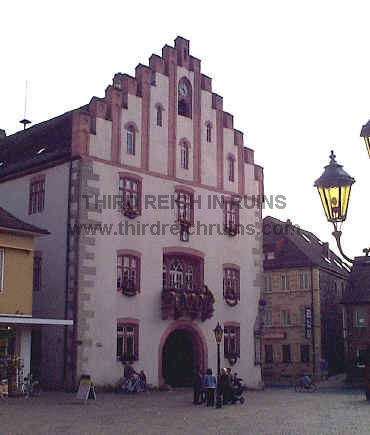
The
Hammelburg Rathaus (town hall) decorated for the first Nazi Tag der Arbeit (Labor
Day) in May 1933. Postwar changes to the charming Hammelburg Marktplatz have been
minimal. (period photo from a private collection) (MapQuest
Map Link) |

|

|
The
Hammelburg Training Area was the scene of intense field training for Hitler's bodyguard
unit, the Leibstandarte-SS, in June 1935. This group photo of the 1st Kompanie was taken
in front of one of the older barracks buildings. This particular building apparently no
longer exists, but there is a similar building among those that remain, that were later
used to house POWs during the war. (Hans Quassowski, ed., "Zwölf Jahre:
1.Kompanie Leibstandarte SS Adolf Hitler," Rosenheim, Deutsche Verlagsgesellschaft,
1989) |

|

|
The
1.Kompanie of the Leibstandarte arrives at the Hammelburg rail station in June 1935. This
was also the arrival point for the Hetzer tank destroyers that helped defeat
Task Force Baum in March 1945.
(Hans
Quassowski, ed., "Zwölf Jahre: 1.Kompanie Leibstandarte SS Adolf Hitler,"
Rosenheim, Deutsche Verlagsgesellschaft, 1989) |
-
|

|

|
| The town
of Arnstein is about 16 kilometers south of Hammelburg. This building,
the Hutten-Spital, served as the headquarters for the Johann
Strauss Battalion of the Reichs Arbeitsdienst - the
Labor Service. It is now a school. (period postcard) (MapQuest
Map Link) (Click here
to see other RAD buildings in Neustadt bei Coburg and Neustadt an der
Aisch.) |

|



