|
Schweinfurt, Part 3
Flak (Anti-Aircraft)
Defenses of the City
Due to the
importance of the ball and roller bearing industry concentrated in Schweinfurt,
the city was defended by a ring of anti-aircraft batteries, called Flak
in German - a contraction of Flugabwehrkanone or Fliegerabwehrkanone
(aircraft defense cannon). Flak gun and searchlight positions were established
all around Schweinfurt to protect the industrial areas against attack from any
direction, although the bombers normally came from the southwest, as this
allowed the bomber streams to most efficiently target the bearing factories on
the west side of town. By the end of the war, some 140 flak guns ranging from
light 2.0cm guns to the standard 8.8cm gun (the famous "Eighty-Eight")
were in place, as well as nine
searchlight positions (at times some mobile 10.5cm guns were mounted on rail
cars). The light 2.0cm and 3.7cm guns were meant as defense
against low-flying fighters and fighter-bombers, while the 8.8cm and 10.5cm guns targeted
the high altitude B-17 bombers.
Although the
Schweinfurt flak batteries were credited with shooting down some enemy aircraft
during the bombing attacks, and they undoubtedly damaged many others, the main
purpose of the flak was to disrupt the bomber streams and ruin their aim
(although this would naturally lead to more collateral damage away from the
actual factory areas). Some of the flak batteries also engaged the advancing
American forces in early April 1945, firing both indirect and direct fire
against the ground targets.
The major 8.8cm flak
batteries were located in the following areas. Not all of these batteries were
in place at the same time, and not all contained the gun numbers shown below on
a permanent basis - some of the battery positions were later abandoned and the
guns moved to other locations. The small caliber guns were normally located
close to the bearing factories, or in support of the larger flak batteries. The
main batteries were, clockwise from the north:
Hambach - 12 guns 8.8cm
Deutschhof - 12 guns 8.8cm
Kaltenhof - 12 guns 8.8cm
Sennfeld/Gochsheim - 12 guns 8.8cm
Spitalholz - 6 guns 8.8cm
Schwebheim - 12 guns 8.8cm
Röthlein - 12 guns 8.8cm
Grafenrheinfeld - 19 guns 8.8cm
Oberndorf - 6 guns 8.8cm
Bergrheinfeld - 18 guns 8.8cm
Ettleben - 18 guns 8.8cm
Geldersheim - 6 guns 8.8cm
Euerbach - 12 guns 8.8cm
Grossbatterie Panzerkaserne - 18 guns 8.8cm
At times there were four batteries of 10.5cm flak guns on rail cars parked at
various locations: near the Kugelfischer bearing works, on a siding in
Niederwerrn, on a siding in the woods near the Bergrheinfeld station, and on a
siding in Gochsheim.
 |
 |
 |
| Examples
of the light flak guns - on the left, the 2.0cm Flak 38 gun in a single
mount; in the center, the 3.7cm Flak 37; on the right, the four-barrel
2.0cm Flakvierling 38. (gun on the right is on display in the Museum
Stammheim am Main) |
 |
 |
 |
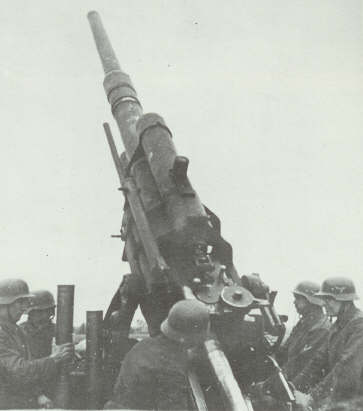
| The
famous "Eighty-Eight" was the primary flak gun used in the
defenses of Schweinfurt. Several models of the 8.8cm flak gun existed; the
photo at left above shows the Flak 36 model; the center photo shows the
Flak 37 model. In the
center photo, the soldiers at the left are using the automatic fuse
setter located on the left side of the gun (see next photo set). (Bundesarchiv) |
|

|

|
|
The Flak 37 models of the 88
gun seen here show the automatic fuse setter on the left side of the gun
mount. A crewman sat in front of
the mechanism and dialed in the correct setting for the fuses, based
on the range and height of the target bomber formations, while another
crewman placed the high explosive rounds with time fuses, nose-first,
into one of two receptacle cups on the side of the mechanism
(right-hand photo), which automatically set the fuses to the proper
time delay.
|
|

|

|
|
8.8cm Flak 18 model guns in
the Schweinfurt flak batteries. (author's collection)
|
|

|

|
|

|

|
|
On the left, guns of the
Schweinfurt flak batteries engage targets at night. On the right is a
view of a gun position during the winter of 1944-45 - not a pleasant
assignment. (author's collection)
|
|

|

|
|
The city defense flak guns
were normally mounted in permanent positions, surrounded by
quadrangular earthen berms, which provided some protection against
shrapnel from nearby bomb bursts. The 8.8cm guns were usually grouped
in batteries of six guns, often in a hexagonal arrangement. The
drawing on the left above shows a plan for an 8.8cm gun emplacement.
On the right above is an Eighty-Eight firing from its emplacement at
night.
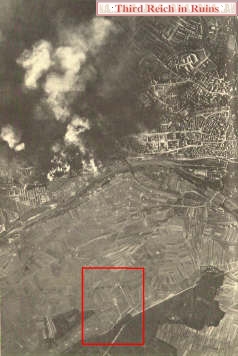
The October 1943 aerial photo
on the right below shows the area near the Panzer Kaserne (buildings
at the bottom), with bomb damage showing
from the previous attack in August. The hexagonal features outlined in
red are two batteries of 8.8cm flak guns (six guns in each
battery), part of the Großbatterie Panzerkaserne, which would
eventually number 20 guns and several searchlights, rangefinders, and
radar antennas. One of the earthen berm gun emplacements for the
Schweinfurt batteries still exists (seen on the left below), near the
former U.S. Army Ledward Barracks (1936 Panzer Kaserne).
The arrow highlights the gun emplacement that still exists. (above
- Bundesarchiv; below - U.S. National Archives, RG 343FH-22426
(detail)
|

|

|
 |
 |
| These
photos were taken among the Flak 37 model 8.8 guns of the Großbatterie Panzerkaserne
(in a six-gun position that was just off the left edge of the aerial
photo above). The
crews of the Schweinfurt flak guns consisted of Luftwaffe flak personnel
and Reichsarbeitsdienst (RAD) workers (Labor Service), who
actually manned the guns in action, assisted by teenage Flakhelfer
personnel and even a few Russian prisoners of war. Even though the school boy Flak
Helpers were only supposed to carry ammunition and perform other support roles,
they did sometimes actually load and fire the guns (particularly in late
1944 and 1945). The crewmen shown here, including Edmund Scheckenbach
(seen in the photo above and some below) lived in barracks near the guns
and trained to a high state of readiness. In the photo on the left
below, a crewman is loading the 8.8cm cartridge into the breech. (Many
thanks to Alan and Edmund Scheckenbach for providing these photos!) |
 |
 |
 |
 |
- -
|

|

|
|
This photo taken during the
bombing attack on 14 October 1943 shows two of the Schweinfurt flak
batteries. Outlined in red at the top is a six-gun position near
Geldersheim; at the bottom are two six-gun positions at
Grafenrheinfeld (seen enlarged on the right). (U.S. National
Archives, RG 343FH-3A22431)
|
-
 |
 |
| These
photos show 8.8cm Flak 37 model guns in the Grafenrheinfeld batteries. The white rings around the barrel of Gun C
("Cesar") - above left - indicated enemy aircraft shot down.
On the left below, RAD flak crewmen clean the disassembled breech block.
Thorough cleaning after firing was necessary to keep the guns
functioning properly. These photos also show details of the gun
emplacement construction with integral ammunition storage areas. The
battery barracks were damaged during the bombing on 24 February 1944,
seen on the right below. (author's collection) |
 |
 |
-
 |
 |
 |
| Batterie Spitalholz was a
concentration of flak guns defending Schweinfurt from across the river
south of the city. Several 8.8cm anti-aircraft guns were
emplaced here in earthen positions. (left/center - U.S. National Archives, RG
343FH-3A22457; right - Museum
Stammheim am Main) |
|

|

|
|
Part of the Spitalholz Battery
after one of the bombing attacks - the guns in their
earthworks still point skyward, while the target areas burn in the
distance. An Autobahn highway was built through
here in the 1960s, with an interchange in this area, and growth of the Hafen
industrial and business area has obliterated any resemblance to the
period photo. (Stadtarchiv Schweinfurt)
|
|

|

|
|
Light flak guns protecting the
Fichtel & Sachs factory. These 2.0cm guns were emplaced in several
locations around the factory areas, including some mounted on the
building roofs. Below, Luftwaffe personnel train
young Flak Helpers on a 2.0cm gun. (author's collection;
above right - courtesy Mike Haines)
|

|

|
|

|

|
|
2.0cm Flakvierling 38
four-barrel light flak guns of the Fichtel & Sachs factory
defenses. (author's collection)
|

|

|
|

|

|
|
Flak rounds burst among the
bomber formations - the photo on the left was taken during one of the
Schweinfurt missions, but the photo on the right does not show
Schweinfurt. One of the goals of the flak barrages, in addition to
damaging and shooting down planes, was to disrupt the bomber
formations and ruin their aim. (U.S. National Archives)
|
-
|

|

|
|
One of the Allied casualties -
a B-17 crash-landed near Elfershausen (northwest of Schweinfurt). This
is B-17F #42-30191 of the 379th Bomb Group, "The Bolevich,"
piloted by Lt. Donald W. Merchant. This plane suffered hits from
fighters and flak during the 17 August 1943 attack and crashed-landed
shortly after the bomb run, killing T/Sgt. Gene Hecht, whose parachute
failed to open. According to period German reports, the plane
came down in this location south of Elfershausen, and was a victim of
the Schweinfurt flak batteries (not fighters). German reports gave
credit to the batteries at Geldersheim, Oberndorf, Deutschhof, and the
Großbatterie
Panzerkaserne. (private collection) (MapQuest
Map Link)
|
|

|

|
|
Further B-17s shot down in the
Schweinfurt area. The bomber above, B-17G #42-46103, was shot down by the
combined fire of the Schweinfurt flak batteries at Deutschhof,
Kaltenhof, and Sennfeld on 21 July 1944 and crashed
on the Maibacher Höhe northwest of the city center, killing two
crewmen in the process. The tail fell in
the area near Air Raid Shelter #4, seen at the left edge of
the modern photo. Below - B-17G #42-23550, commanded by 2nd Lt. Alden
Kincaid of the 305th Bomb Group, was shot down near Waigolshausen on 14 October
1943, losing three crewmen killed. (above - Stadtarchiv Schweinfurt; below -
Historisches Verein Waigolshausen)
|

|
|

|

|
|
In addition to the flak guns
themselves, the flak battery positions included various support
equipment such as range finders, searchlights, acoustic trackers, and
command and control centers. Above is a Kdo. Gr. 36 four-meter base
range finder. Below is a 150cm searchlight. Both original pieces are
on display in the Museum
Stammheim am Main. (above - U.S. War Dept. TM E9-369A,
"German 88-MM Antiaircraft Gun Materiel," 29 June 1943; below - Bundesarchiv)
|

|

|
|

|

|
|
Crewmen of one of the control
positions associated with the Schweinfurt batteries operate a range
finder and communications equipment. On the right, RAD flak crewmen of
the Großbatterie Panzerkaserne dig out a dud 500-pound bomb
after one of the bombing attacks. (left - author's
collection; right - courtesy Alan and Edmund Scheckenbach)
|
-
|

|

|
|
Located near the two 6-gun
flak batteries south of Euerbach was a part of the German early
warning and fighter control radar net. This radar station was
code-named "Wildschwein," and consisted of a
"Freya" long-range radar antenna and two "Würzburg-Riese"
radar dishes, along with associated barracks and administrative
buildings. The hexagonal concrete bases for the two "Würzburg-Riese"
radar sets remain today, and one has recently been incorporated into a
local Peace Memorial (the light coloring on the concrete is not paint,
but is where the lower part of the base was covered by the slope, and
only recently excavated). Below is a 1945 photo of a "Würzburg-Riese"
dish in place on its concrete base. (Click here
to see ruins of a similar radar site in northern Bavaria.) (Google
Maps© Link) (author's collection)
|

|

|
|

|

|
|
The concrete base for the
other "Würzburg-Riese" radar dish is in a nearby field. An
opening on one side of the base allowed access to the mount and wiring
inside, and also for passage of the buried electrical cables. (U.S.
National Archives, RG342-FH) (Google
Maps© Link)
|

This U.S. Army Air Forces aerial
reconnaissance photo shows the two 6-gun Euerbach flak batteries (large circles)
and the upper Würzburg-Riese radar installation
(smaller circle at left). The other Würzburg-Riese radar dish is out
of view to the left. (courtesy Deutsch-Amerikanisches
Nachkriegsmuseum)

The two 8.8cm flak gun positions outlined in the
battery on the right in the period photo above
can still be seen at some times of the year as
differences in the crop outlines in satellite views
(click here
- This view is from 2008, from the Google Maps © history file).
|

|

|
|
During the latter part of the war, the searchlights and other support
equipment, along with the radar stations, were generally
operated by female Luftwaffe auxiliaries, the Flakhelferinnen and
Nachrichtenhelferinnen.
These "flak helpers" and "Blitz Mädels" (signals
girls) were youths
in their teens or early 20s, who also helped coordinate the battery
communications and, on rare occasions, crew the flak guns. (private
collection)
|
|

|

|
|
These photos show a building
on Ludwigstraße in the suburb of Niederwerrn, which served as a
command and control bunker for the Schweinfurt area air defenses,
under the command of Flak-Regiment 179. After the war, windows were
cut through the concrete walls, and the building has served as an auto
repair shop. (My thanks to Mike Haines for alerting me to
this "bunker" in Niederwerrn, and to Lt. Col. Juan Hernandez
(Ret.) for info on its wartime purpose.)
|
-

Many of the flak batteries engaged the
advancing U.S. Army troops from 6-10 April 1945, firing both
indirect and direct fire missions, destroying several tanks in the process. In
particular, the batteries at Ettleben,
Schwebheim, and Hambach delayed the American advance significantly, until their
ammunition was exhausted.
When the U.S. Army moved into Schweinfurt on 11 April 1945,
the flak
batteries had been abandoned,
the guns
put out of action. The guns seen here were found abandoned by the infantrymen
of the 42nd Division.
(42nd "Rainbow" Infantry Division, 1946)
-
|

|

|
|
This memorial stands at the
site of the large collection of flak guns near Ettleben, southwest of
Schweinfurt. These guns were directly beneath the usual bomber route
to the bearing factory targets, plus they were in the path of the
advancing American forces in early April 1945. On the night of 8
April, after delaying the U.S. advance for three days, and recognizing the
futility of further fighting, the battery commander ordered all the
remaining ammunition to be expended, then the guns were disabled and
the crews (mostly teenage flak helpers) fell back into the city.
|
An ammunition storage depot for
the Luftwaffe flak batteries was built near the town of Rottershausen, a few kilometers north
of Schweinfurt. Click here to visit a page
showing the remains of bunkers at this site today.
I wish to acknowledge the kind
assistance of the staff of the Stadtarchiv Schweinfurt provided during my photo
research there.
 Continue to Schweinfurt, Part 4 --
air defense bunkers
Continue to Schweinfurt, Part 4 --
air defense bunkers
 Back to the Third Reich in Ruins homepage Back to the Third Reich in Ruins homepage
Click
here for a link to a MapQuest map of Schweinfurt.
|



