|
Further Berchtesgaden Area
Sites
The quaint mountain village of Oberau, northeast of the Obersalzberg, was the location of two Third Reich
facilities.
|

|

|
| The
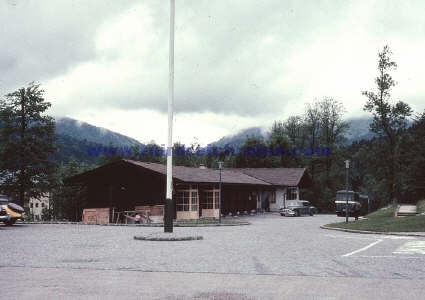
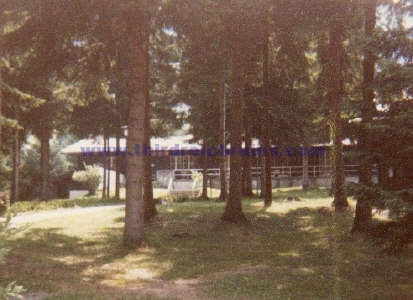
period view shows a small barracks complex for the SS, built in the
Vochenbichl area of Oberau. These wooden buildings were taken over by
the U.S. Army in 1945, and were used for several years to house
Displaced Persons (refugees). They were torn down several years ago, but
foundation remains can be seen near the Oberau Sportplatz. (MapQuest
Map Link) |
 |
 |
|
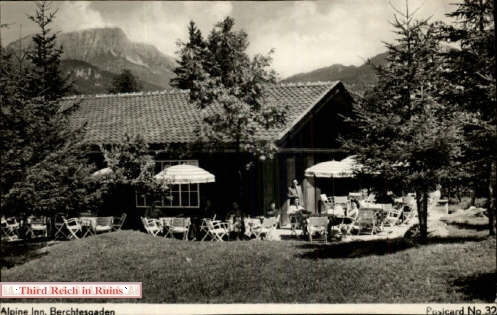
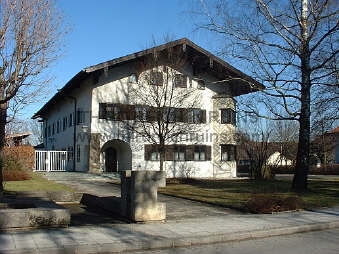
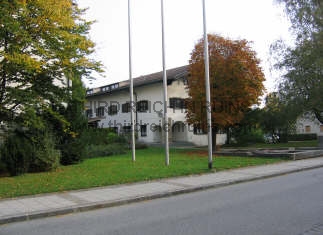
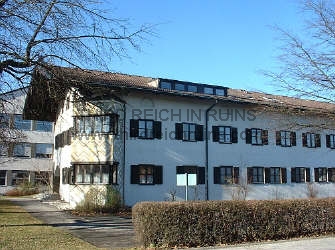
This building, now the Gasthof Auerwirt
in Oberau, was remodeled in 1937 as a home
for the Hitler Jugend.
Hitler himself made a large contribution toward the reconstruction. (MapQuest
Map Link)
|
-
-
 |
 |
|
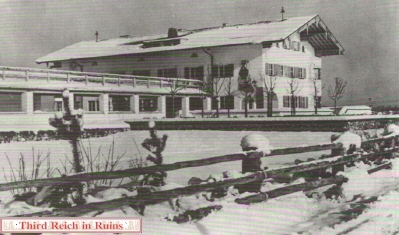
"Haus Köppeleck" in Schönau
am Königssee was used as a Kinderlandverschickung (KLV) Lager - a location for
vacations for city children in rural areas, and later as camps for children
evacuated from cities that were bombing targets. A group of Bund Deutscher
Mädel (BDM - girls Hitler Youth) visit at left. (Adolf Schmidt, "Jugend
im Reich," Berlin, 1942) (Google
Maps link)
|
Königssee
Area Sites
|

|
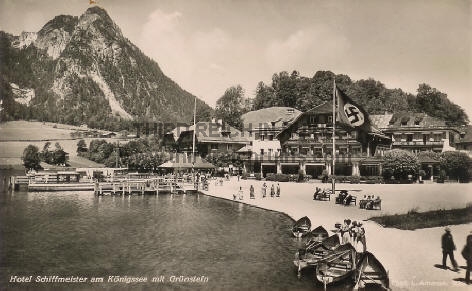
The beautiful
mountain lake Königssee, south of Berchtesgaden, was a favorite destination for Hitler and Eva Braun
on a sunny summer day. In
this 1938 view, a Nazi flag can be seen in front of the famous Hotel Schiffmeister.
Below, my father photographed the Hotel Schiffmeister in 1946. (above
- period
postcard in author's collection; below - collection of G.A. and G.R. Walden) (MapQuest
Map Link) |
 |
 |
 |
| Another
period postcard view of the Nazi flag flying in front of the Hotel
Schiffmeister. |
 |
 |
Eva
Braun particularly liked to visit a beach at the Königssee, where she practiced gymnastics. The view is practically
unchanged today.
(US National Archives, RG242-EB; below right - courtesy Craig McGill) |
 |
 |
 |
 |
| The beach area described above was near
the base of the Königsbach waterfall, which forms a natural water tank at the
bottom. The remoteness
of this location allowed Eva's family and friends to bathe in the nude. These
stills, from Eva Braun's movie collections, are invariably labeled as showing Eva
herself, but this was actually her sister Gretl. (stills from Eva Braun's movie collection in the U.S. National
Archives, RG 242.2; right - courtesy Craig
McGill) |
 |
 |
 |
 |
|
Up the slope of the fall itself was
another favorite spot for Eva Braun and her friends to bathe - a series of
natural water tanks formed as the fall flows over rock shelves. (left -
still from Eva Braun's movie collection in the U.S. National
Archives, RG 242.2; right - courtesy Ralf
Hornberger)
|
 |
 |
| Eva
Braun also enjoyed visiting the Schliersee, a lake near the Tegernsee
lake, south of Munich, where she exercised on a bar. The area where her
apparatus was set up is now a private camp ground. (U.S.
National Archives, RG 242.2) (Google
Maps Link) |
 |
 |
| Adolf
Hitler also visited the Königssee. Here he is seen on a boat on the
lake, with the Sankt Bartholomä chapel in the background. (Heinrich Hoffmann,
"Hitler in seinen Bergen," Munich, 1938) |
 |
 |
 |
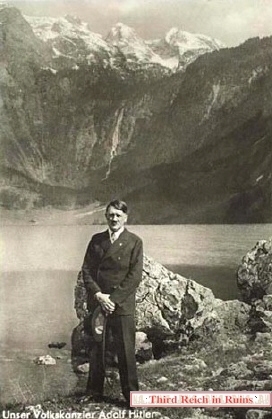
| At the
south end of lake Königssee, separated by a narrow isthmus of land, is
the Obersee (this was likely once all one lake, with the isthmus the
result of an avalanche sometime in the past). Adolf Hitler visited the
Obersee on at least two occasions, for photo opportunities. The views
above show a visit in May 1933. The rock just behind Hitler is easily
identifiable today, although the lake level is now somewhat different
(the water level fluctuates with the season). (left - period postcard; right -
Cigaretten-Bilderdienst Altona-Bahrenfeld, "Kampf um's Dritte Reich"
(1933) (MapQuest
Map Link) |
 |
 |
 |
| On
another occasion Hitler visited in uniform. He posed on another rock
just to the right of the rock seen in the earlier views. This rock is
often surrounded by water today. (Heinrich Hoffmann,
"Hitler in seinen Bergen," Munich, 1938) |
 |
 |
| Reichsmarschall
Hermann Göring, an avid hunter and outdoorsman, had a special hunting
lodge built in the Roth area in the mountains surrounding the Obersee.
The lodge was torn down after the war and the site is difficult to visit
today, reachable only by way of a long hike and climb into the
mountains. However, the approximate site can be seen from the Königssee
boat landing at Salet - the landing for the Obersee path - the site was below the distinctive
notch in the mountains that can be seen in the distance (the actual site
is not visible from here - it was on the other side of the wooded ridge
seen in the modern photo). |
 |
Hintersee
Sites
 |
 |
| The
Hintersee is an alpine lake to the west of Berchtesgaden, surrounded by
the "Magic Forest" (Zauberwald) - a favorite hiking
area today. In May 1945 the Hintersee area became the final command post
of the Berchtesgaden/Obersalzberg Nazi leadership. Above is the Altes Zollhaus or old Customs House.
This is the last building on the road leading to the border with Austria
at Hirschbichl (closed to
private vehicles). It was bought in 1939 by Fritz Todt, main engineer of
Hitler's Autobahn system and later Armaments Minister during the war.
Todt's family lived here during the war, which is why Todt has a
cenotaph in the Berchtesgaden Bergfriedhof
cemetery (he was actually buried in the Invalidenfriedhof
military cemetery in Berlin). (period photo from Eduard Schönleben, "Fritz
Todt," 1943) (MapQuest
Map Link) |
 |
 |
| The
building on the left above is the Altes Forsthaus or forestry
headquarters, up the road from the Todt house (toward the lake). In
early May 1945 Hans Lammers, chief of the Reichskanzlei,
moved his staff here. One of Hitler's armored Mercedes cars was found
here by soldiers of the 101st Airborne Division. The
hotel seen on the right above is the Gasthof Alpenhof (sometimes referred
to as "Bartels," after the owner). Adjutant Albert Bormann
moved his operations here following the destruction of the Obersalzberg
in late April 1945. Others of the staff who had moved from Berlin to the
Obersalzberg around 22 April 1945 also ended up here and at the Hotel
Post, including Adjutant
Julius Schaub and secretary Christa Schroeder. The Alpenhof's Stube
still has wood carvings reminiscent of the Third Reich era. (MapQuest
Map Link) |
 |
 |
| The
Hotel Post on the Hintersee was used in earlier times to house various dignitaries
visiting the Nazi hierarchy on the Obersalzberg. This hotel and Bartels
Alpenhof are
located directly on the Hintersee lake, with outstanding views of the
surrounding mountains (the former Hotel Post is now the Gästehaus
Hintersee). In the postcard view on the right, Hitler greets local
children at the Hotel Post. |
 |
 |
| Hitler
relaxes on the terrace of the Seeklause hotel with his press chief Otto
Dietrich. In the period postcard view below, he is seen with his
personal adjutant Wilhelm Brückner. (Heinrich Hoffmann, "Hitler in seinen
Bergen," Munich, 1938; below right - courtesy Craig McGill) |
 |
 |
Bad
Reichenhall Area Sites
|

|
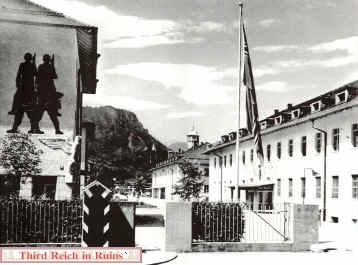
A military
barracks complex was built in Bad Reichenhall, north of Berchtesgaden. This was the
Gebirgs-Artillerie-Kaserne (for mountain artillery troops), also called the
Ritter-von-Tutschek-Kaserne (now called the Hochstaufen Kaserne). The swastika below the eagle at the corner of the building has been
changed to an edelweiss flower. Click here
to see more photos of the Bad Reichenhall barracks. (from period postcards; photo below-right from a private
collection)
(MapQuest
Map Link) |
|

|

|

|

|
The
period soldier paintings no longer appear on this building down the street,
at another gate to the barracks. The 1940-dated postcard view shows the
site when it was called Mackensen-Kaserne. (period
postcard in author's collection; my thanks to Torben Behrens for info about
this site) |
 |
 |
| A
popular tourist destination is the Predigtstuhl mountain above Bad
Reichenhall. The cable car system to the mountain resort, built in 1928,
is the oldest continually-operating cable car in the world (much of the
system, including the cable itself, is original to 1928). Hitler, who
was reportedly afraid of heights, visited the Predigtstuhl for a photo
opportunity (although this may have been his only visit). (above
- Heinrich Hoffmann, "Hitler in seinen
Bergen," Munich, 1938; below - period postcard) |
 |
 |
-
Kleßheim Palace near Salzburg,
Austria

|

|
The
early 18th century Kleßheim Palace near Salzburg, Austria, was used by
the Nazis to house high-ranking visitors to Hitler's Berghof, including
German Foreign
Minister Joachim von Ribbentrop, Italian leader Benito Mussolini and his
Foreign Minister Graf Ciano, Romanian president Antonescu, Slovakian
president Tiso, Admiral Miklós Horthy of Hungary, and
others. It was occupied by the U.S. Army after the war - the period photo
above shows the band of the 30th Infantry Regiment, 3rd Infantry Division,
parading in review in May 1945. The victors have put up a 3rd I.D.
insignia over the main doorway, but German camouflage netting still
remains on much of the building (dark areas in the photo). The entrance
gate to the complex was rebuilt in 1942, with two large eagles added, but
these eagles never had swastikas. The palace now houses the Salzburg
Casino. (Donald G. Taggart, "History of the Third Infantry
Division in World War II," Washington, Infantry Journal Press,
1947) (MapQuest
Map Link) |
 |
 |
 Continue to the Obersalzberg sites - Hitler's
Berghof, Bormann's and Göring's houses, Platterhof, Gästehaus and Kampfhäusl, Hotel Zum Türken,
Gutshof and Teehaus,
Kehlsteinhaus, SS barracks, bunker system,
SS guard houses,
miscellaneous Obersalzberg
buildings.
Continue to the Obersalzberg sites - Hitler's
Berghof, Bormann's and Göring's houses, Platterhof, Gästehaus and Kampfhäusl, Hotel Zum Türken,
Gutshof and Teehaus,
Kehlsteinhaus, SS barracks, bunker system,
SS guard houses,
miscellaneous Obersalzberg
buildings.
 Return to the Third Reich in Ruins homepage
For further information, including Internet links, check
the Bibliography page.
 |
My guide
book to Third Reich sites in the Berchtesgaden and Obersalzberg area has
been published by Fonthill Media.
"Hitler's
Berchtesgaden" is available at Amazon and other retailers (the
Kindle version is also available from Amazon). |
Guided Tours
For personal guided tours in
English of Third Reich sites in Berchtesgaden and on the Obersalzberg (and other
local sites) from a certified and accredited local tour guide, contact:
Tom Lewis
+49-(0)1602-641-800
atobersalzberg@sky.com

BEGAFILM
- Historic Films About Berechtesgaden and the Obersalzberg
|