|
Berlin -- Haus des Deutschen Sports and 1936
Olympic Village
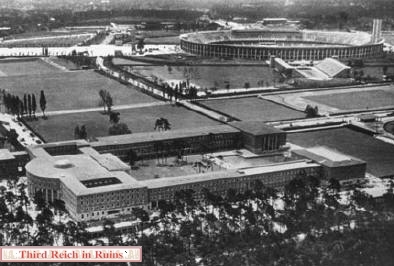
The area of the Reichsportsfeld
adjacent to the Berlin Olympic Stadium included the Haus des
Deutschen Sports and other buildings. This area was not badly damaged
during the war, and was taken over in 1945 as the headquarters of the British
military contingent in Berlin. Returned to German control in the mid-1990s, much of this
area remains today as it did in 1936, still a sports center.
Click here
to proceed directly to the section on the Olympic Village.
 |
 |
| Period
views (above) of the Haus des Deutschen Sports complex, with the Olympic
Stadium seen in the background on the left. Below are the courtyard (Jahnplatz) and
main building of the complex, with two period sculptures by Arno Breker
on the portico. (Werner Rittich,
"Architektur und Bauplastik der Gegenwart," Berlin, 1938) (MapQuest
Map Link) |
 |
 |
 |
 |
| Above,
Arno Breker's Zehnkämpfer (Decathlete), and below, Siegerin (Champion), still in their original
locations. (Werner Rittich,
"Architektur und Bauplastik der Gegenwart," Berlin, 1938) |
 |
 |
 |
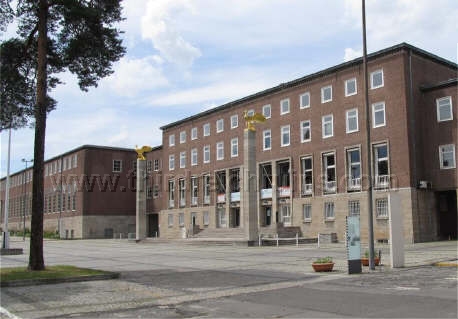 |
| The main
entrance on the other side of the complex fronted on the Adlerhof,
or "Eagle Square," named for the two golden eagles on pylons.
In the period view at left, a group of German female athletes marches
past. |
 |
 |
| These
terracotta reliefs by Arno Lehmann of (left) horsemen and (right) track and field athletes decorate
the inner doorways facing onto the open court (Jahnplatz). (Thanks
to Sheila Luecht for info) |
 |
 |
| Georg
Kolbe's sculpture Ruhende Athlet (Resting Athlete). Below, Argentinean
swimmer Jeannette Campbell poses with the Resting Athlete,
August 1936. (above - Werner Rittich,
"Architektur und Bauplastik der Gegenwart," Berlin, 1938; below -
"Die Olympischen Spiele 1936," Hamburg-Bahrenfeld, Cigaretten
Bilderdienst, 1936) |
 |
 |
 |
 |
| On the
left, the pool where Campbell competed is adjacent to the Olympic
Stadium, and is still used for swimming competitions. On the right,
sculptures of a bull and cow by Adolf Strübe at the end of the Haus des
Deutschen Sports courtyard (Jahnplatz), symbolizing strength and fertility. |
 |
 |
| The Haus des Deutschen Sports
still displays other reminders of the Olympics, such as this windvane
dated 1936. |
1936
Olympic Village Site
The
remains of the 1936 Olympic Village built to house the visiting athletes
can still be found near the village of Elstal, west of Berlin on Hwy.
B5. Most of the athlete quarters were removed under Soviet occupation
(there was a large Soviet military post just across the highway), but a
few of the main 1936 buildings remain. (MapQuest
Map Link)
 |
 |
| On the
left, the following buildings can be seen from left-right: Swimming
Hall, athletes' houses, Dining Facility (in the distance). The building
on the right was the site Commander's house. |
 |
 |
| The
Hindenburg Haus was the main administration building in the Olympic
Village. It boasted a television viewing room, since the 1936 Olympics
were broadcast live (mainly to public TV sets). |
 |
 |
| Many of
the original 1936 buildings at the site, including the Swimming Hall,
are in a somewhat ruined condition today. (2012 note - the Swimming
Hall is currently undergoing restoration.) |
 |
 |
| The huge
Dining Hall (left) and gymnasium (right) are also in a dilapidated
condition. However, the site is now being preserved. Some of these
buildings no longer present their exact 1936 appearance, because this site
was used by the Soviet and East German military forces for many years. |
 |
 |
| Famed
American runner Jesse Owens lived in a house that has been restored,
including his room (below). However, most of the 1936 athletes' houses
were either rebuilt/remodeled after the war or town down. The 1936
houses were wooden structures, similar to that seen on the right (which
has been partially dismantled). |
 |
 |
 |
 |
| Rudolf Hess tours the Olympic Village in
1936, with a similar perspective today. The large building in the
background is the Dining Hall. (Bundesarchiv) |
 |
 |
| The
"Dining Hall of the Nations" was designed to accommodate the
nearly 5000 Olympic athletes and staff who lived and worked in the
village. The building also housed the village heating system and power
plant, garages, and other support necessities. The original Olympic
Rings from the roof of the structure are stored in the gymnasium today.
(Official Report, the XIth Olympic Games, Berlin 1936 (Berlin, 1937) |
 |
 |

The Dining Hall during the 1936
Olympics. Curiously, the flag flying from the roof is the Reichskriegsflagge,
which was the military War Flag, not the national swastika banner. (Bundesarchiv)
|

|

|
| Much
of the area of the removed 1936 houses was taken up by barracks
buildings for the Soviet and East German military units that occupied
this site. The photo on the right above shows a post-war concrete guard bunker at
the site. |
The 1936 Olympic Village site is
now being preserved and is open to the public. More info here (in German) - http://www.historia-elstal.de/olympisches-dorf/,
and here - http://www.olympisches-dorf.de/.
This is a great photo and text
site with many details on the Olympic Village - https://www.olympicvillage1936.com/
.
 Back to the Berlin page
Back to the Third Reich in
Ruins homepage
|


