|
Nürnberg Part 2
The Nazi Party Rally Grounds
Luitpold Arena, Ehrenhalle, and
Zeppelinfeld

This architectural model by Albert Speer
shows the planned
completed state of the Parteitagsgelände (Party Rally Grounds).
At the top is the Märzfeld,
a large field for military maneuvers and parades. From there, the Große Straße (Great
Road)
was to lead past the
Deutsche Stadion (large coliseum on the right), to the Kongreßhalle (lower center),
with
the
Luitpold Arena at the bottom.
At the left side of the model is the Zeppelintribüne and Zeppelinfeld.
Several of
the structures
shown here were never built,
such as the Deutsche Stadion, the pylons at the end of the
Große Straße, the Culture Hall
(opposite the Kongreßhalle), and the Exhibit
Hall (low building near the Kongreßhalle).
The Kongreßhalle and the Märzfeld
were never finished. (from "Das Bauen im neuen Reich" by Fr. Prof. Gerdy Troost, Bayreuth, 1938)
Click
here for a MapQuest map showing the Reichsparteitagsgelände area.
(This link points specifically to the Zeppelintribüne; you can orient
this map to the rest of the site using the plan above.)
Luitpold Arena

|

|
The Luitpold Arena could hold over
150,000 Nazis, and was the scene of SS and SA gatherings. At one end was the Ehrenhalle, a
war memorial built in 1929. The arena is now a large grassy
park, very popular on sunny afternoons. Only the Ehrenhalle is left at this end,
the adjacent grandstands having been removed. (U.S.
National Archives RG 242) |

|

|
|
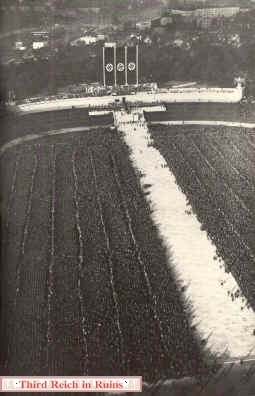
The other end of the Luitpold
Arena was a grandstand with a speaker's platform and three tall swastika banners, designed by
Albert Speer. The large eagles on either end were by the sculptor Kurt
Schmid-Ehmen. On the right above,
the ruins as seen by U.S. Army GIs on 27 April 1945. Only the steps at one
end of this grandstand remain today, all the other ruins having been
removed and covered over with earth. (above left and below -
period postcards; above right - National Archives Record Group 111-SC, #205452) |
 |
 |
|

|

|
|
These aerial views show the Luitpold
Arena, with the Ehrenhalle at the lower center and the grandstand at the
upper center (in the view on the left). The
long building at the upper left was the Luitpoldhalle, scene of the Nazi Party
congresses. The Luitpoldhalle was a converted industrial exhibition building. It
was badly damaged during wartime bombing attacks and its ruins were later
removed. (period postcards)
|
|

|

|
|
A view of the Luitpold Arena podium during a
Reichsparteitag celebration. (Life collection) |
Period postcard of the Luitpoldhalle decorated for
a
Reichsparteitag celebration. (courtesy Al Taylor) |

A nazi gathering in the Luitpoldhalle in
1933, from a period postcard.

|
|
The SS
and SA gathered at the Luitpold Arena to participate in a ceremony honoring Nazi dead at
the Ehrenhalle. On the left - Hitler's speaker's platform. (left -
period postcard; right - National
Archives RG 242-HB) |
 |
 |
| The view
from Hitler's speakers platform looking across the Luitpold Arena toward
the Ehrenhalle. This view shows some of the large bleacher seating areas
that extended around three sides of the Luitpold Arena, which were
removed during post-war rebuilding. The Luitpoldhain park is today a favorite spot for
sunbathers on warm summer days. (1936 postcard) |
 |
 |
| Hitler, flanked by the chiefs of the SS and SA, marched the length of the
arena, to salute the Blutfahne (Blood Banner from the 1923 Munich putsch) at a
memorial wreath laid in front of the Ehrenhalle. (left
- Gerd Rühle, "Das Dritte Reich," Berlin, 1938;
right - Bundesarchiv 102-16196) |
 |
 |
| On the
left, this rare 1933-dated postcard shows Hitler
standing during the
memorial ceremony in front of the Ehrenhalle with his SA chief Ernst
Röhm. Röhm was executed during the 1934 purge of Hitler's perceived
enemies ("Night of the Long Knives"), and Röhm's photo was
removed from subsequent Nazi publications. In the photos shown earlier
on this page, the SA
chief is Röhm's successor Viktor Lutze,
and the SS chief is, of course, Heinrich Himmler. This group is shown in
the painting of the 1934 ceremony seen on the right. (left - author's
collection; right - period postcard) |

An SS officer directs marching columns into place during one of
the annual ceremonies. (U.S. Library of Congress)

|

|
The
view from ground level, in front of the Ehrenhalle. The paving stones at the spot where Hitler
stood have been removed by souvenir hunters (see period photos
above). (period postcard) |

|

|
The
Ehrenhalle (Hall of Honor) was built to memorialize soldiers of the First World War, but
was appropriated by the Nazis. The memorial is now dedicated to all the victims of war and
National Socialism. (1941 postcard in author's collection) |

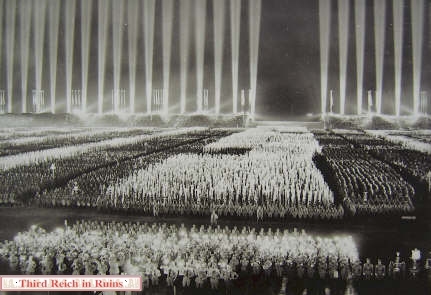
Panoramic view showing 150,000 SS and SA men in
the Luitpold Arena; the Ehrenhalle is in the distance.
(from "Deutschland erwacht - Werden, Kampf un Sieg
der NSDAP," Hamburg, 1933)
|

|

|
| Above,
triumphant U.S. Army soldiers on Hitler's speakers platform in April
1945. On the right is one of Kurt Schmid-Ehmen's eagles showing battle
damage. On the left below, GIs enjoy the "Yankee Doodlers," a
jazz band that played in the Luitpold Arena on 26 April 1945. Below
right, the U.S. Army turned the Luitpold Arena into a vehicle
motor park. Note the curbed shaft entrance at the lower right of this
photo - this was a stairway leading to a tunnel beneath Bayernstraße,
so pedestrians would not have to cross the busy street between the
Luitpold Arena and the Kongreßhalle - this stairway can still be seen
today. (U.S. Army photos; below left - courtesy Digital
History Archive) |
|

|

|

This aerial photo of the Luitpold Arena
taken on 25 April 1945 shows several interesting features. To the left is the Ehrenhalle
with grandstand bleachers
surrounding the arena field; there are no remains of these grandstands today.
Just at the top of the arena are the skeletal girder remains of the bombed
and burned-out Luitpoldhalle. In the upper right corner of the photo are the
buildings of the SS
Kaserne (post-war Merrell Barracks).
(U.S. National Archives, RG 111SC-206739, courtesy Digital
History Archive)
Zeppelinfeld

|

|
Another demonstration field
designed by Albert Speer was the Zeppelinfeld, with its massive colonnaded
Zeppelintribüne grandstand. Above, German athletes and Labor Service
assemble before Hitler at the 1938 Party Rally. (above left - National
Archives RG 242-HB; above right - Bundesarchiv; below - period postcard,
courtesy Rob Berg) |
 |
 |
|

|
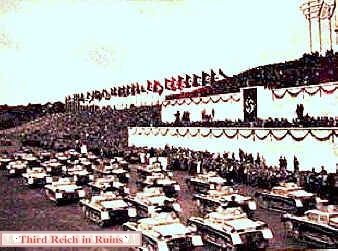
The Zeppelinfeld was first used
for Parteitag demonstrations in 1933, using a provisional wooden grandstand
on the opposite side of the field from the later stone grandstand. On the
left, Pzkw. I tanks parade past the stone grandstand still under
construction in 1934, lacking the later rear façade and side columns. The
first Hoheitszeichen national insignia on the Zeppelintribüne was a large wooden eagle
designed by Albert Speer for the 1933 Parteitag. Right
- a rare color image of the
Zeppelintribüne in its finished state. "Tag der Gemeinschaft" (Day of
Community) during the 1937 Parteitag (Life collection). |

|

|
|
More color images from the 1937
Reichsparteitag. On the right, the girls from the "Glaube und
Schönheit" (Faith and Beauty) movement perform. (Life
collection) |
|

|

|
|
Members of the Kriegsmarine (Navy) parade
past Hitler at the 1935 Parteitag.
This photo shows a good view of Speer's initial wooden eagle.
("Adolf Hitler, Bilder aus dem Leben des Führers," Altona, 1936) |
By 1936, the
Zeppelintribüne grandstand was finished, although the final touches were
not added until 1937. 1936 also saw the completion of the stands surrounding
all sides of the field. Compare this view to the 1945 photo at the
bottom of the page. The long building seen at the center top of this
view was a transformer building for electrical power (see
below). (period postcard) |
 |
 |
| These
comparison views from 1935 (left) and 1938 (right) show the
Zeppelintribüne before the central tribune and the columns were added, and with Speer's
original wooden eagle (on the left), and then in its final configuration. (period
postcards) |
 |
 |
| The
Zeppelintribüne under construction. On the left, Reichs Arbeits Dienst
(RAD) workers parade in 1936. The structure seems complete
except for the large swastika on top and the fire cauldrons on the side pillars. On
the right, girls of the BDM (Bund deutscher Mädel) take a break from a
formation in 1937 - the final touches are being put to the huge gilt
swastika that crowned the grandstand, and the cauldrons have been
mounted. (left - period postcard; right - Ausstellung "Faszination und Gewalt") |
 |
| Comparison views
showing the
Zeppelintribüne under construction in 1937 (above) and in its final
appearance in 1938 (below). In the view above a model stands in for the
gilt wreathed swastika. (above - original photo in author's
collection; below - period postcard) |
 |
|
|
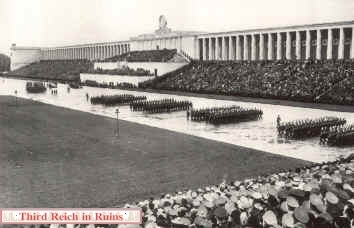
The Zeppelinfeld during a parade
in 1937. The U.S. Army blew up the large
swastika on the top of the Zeppelintribüne in 1945. The columns on either side of the
grandstand were removed in 1967 because they were thought to be deteriorating and
considered dangerous. (Bundesarchiv Koblenz) |

|

|
An artillery crew demonstrates a
150mm howitzer on the Zeppelinfeld during Army Maneuvers Day in 1937. Hitler spoke from the platform at
the center-front of the grandstand (covered with a swastika flag in the photo to the
left). (Bundesarchiv
Koblenz) |

|

|
Hitler at the speaker's platform,
during an RAD (Reichs Arbeits Dienst - Labor Service) rally. An RAD man holds the
Führer's personal standard. A taller iron railing has been
added around the speaker's platform, replacing the original seen in the
period photo. (Bilderdienst Süddeutscher Verlag) |
-

|

|
The SA
assembled on the Zeppelinfeld - a view from just behind the speaker's platform.
The configuration of the steps has been changed since the Nazi period -
originally there was a platform behind the dais with steps leading up on
either side, but these steps and platform were removed in the 1980s and steps were added inside the
speaker's dais - one of
several post-1945 changes to the Zeppelintribüne. Compare this
photo taken in 1945, which shows the original configuration. (Many
visitors who stand
here assume that they are standing on the spot where Hitler once stood, but they actually are
not, due to the added steps - note that the metal railing is also
different.) (Bundesarchiv) |

Hitler at the speaker's platform during the 1938
Parteitag Großdeutschland.
(Gerd Rühle, "Das Dritte Reich," Berlin, 1938 ed.)
|

|
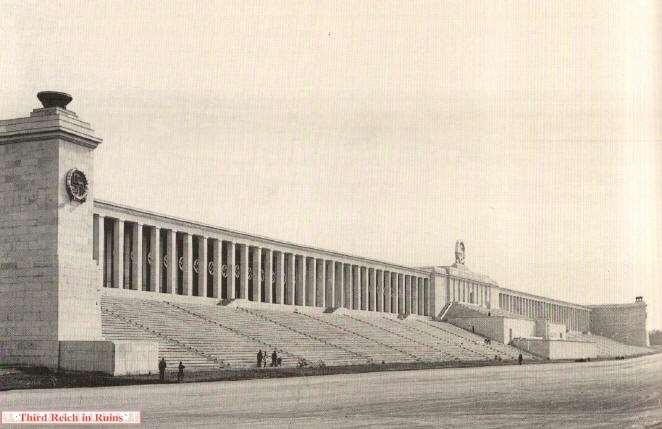
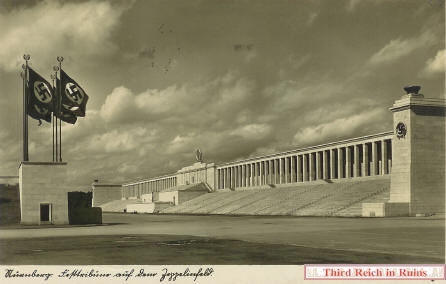
The Zeppelintribüne during its
heyday in the late 1930s. The design was influenced by the Pergamon Altar, a classical
Greek structure from ancient Turkey, on display in a Berlin museum. (left
- 1938-dated
postcard; right - Münchner Illustrierte Presse, 8 September 1938) |

|

|
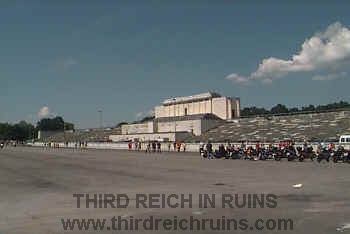
In 1967
the columns on either side were removed. Below, the Zeppelintribüne as it appears
today. The upper parts of the end structures were removed in the mid-1970s.
(Ausstellung "Faszination und Gewalt") |
|

|

|

|
View of the rear of the
Zeppelintribüne. The removal of the side columns in
1967 radically changed this view. The staircases for the side wing doors
in the back of the Tribüne were also removed. (above - Fr. Prof. Gerdy Troost, "Das Bauen in neuen Reich,"
Bayreuth, 1938; below - Hubert Schrade, "Bauten
des Dritten Reiches," Leipzig, 1937) |
|

|
|

|

|
| The Pfeilerhalle,
or Hall of Pillars, on one side of the Zeppelintribüne, with a similar
view today. Note: In 2008 the concreted openings shown here,
covering the stairwells that led from the interior up into the Pfeilerhalle,
were reopened to remove rubble from the staircases beneath. They were
covered over with plywood covers, and these areas are now off-limits and
fenced off. (
Werner Rittich, "Architektur und Bauplastik der Gegenwart," Berlin, 1938) |

|
|
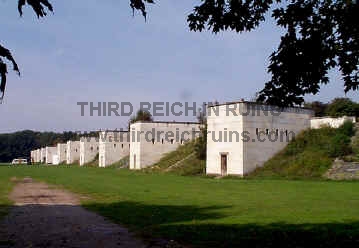
Thirty-four
small buildings were grouped around the periphery of the Zeppelinfeld,
dividing the seating areas. Each mounted six flag poles, but in reality,
the buildings were actually toilet facilities. (Werner Rittich, "Architektur und Bauplastik der Gegenwart," Berlin,
1938; below - 1938-dated postcard; bottom - courtesy Rob Berg) |
|

|
 |
 |

|

|
The large columns at either end of
the Zeppelintribüne mounted cauldrons which were lit during nighttime gatherings. These cauldrons have been
preserved - one (shown above) is inside the Zeppelintribüne (but not
accessible to the public, as the display inside is now closed). The other
is now displayed at the rear of the Zeppelintribüne. It is painted in
garish colors because it used to be located beside the swimming pool at
the nearby Franken Stadium. (National
Archives RG 242-HB) |
|

|
 |
 |
 |
| The display that used to be
inside the Zeppelintribüne is now in the Dokumentationszentrum
museum in the Kongreßhalle, and the
Zeppelintribüne is no longer open to the public, except on special tour
days. The interior of the Zeppelintribüne
is in a somewhat deteriorated condition today. |

|

|
The ceilings inside
the Zeppelintribüne feature intricate mosaics (the mosaic in the Golden
Hall, on the left above, was somewhat restored in the 1960s or 70s). The mosaic on the right
below had a golden swastika in the center, which was removed by the U.S.
Army in 1945. But enough of the golden mosaic tiles remain that you can
still pick out the swastika shape if you look closely. |
 |
 |
-

|
|
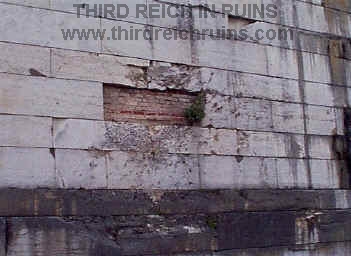
Because the Zeppelintribüne was
built hastily, of somewhat shoddy materials, it is deteriorating today. Wire guards
protect visitors from pieces of masonry that come loose from the upper façade.
The entire rear wall has been fenced off for the same reason. Above right
- A section of the rear wall shows
damage from the impact of a high explosive round, presumably fired in
1945 (see also similar damage to the Kongreßhalle).
These views also show how the Zeppelintribüne, in common with many other Third Reich
structures (such as the Kehlsteinhaus "Eagles
Nest"), was not built of solid rock, but of stone blocks laid over a brick or
concrete base (in this case, limestone laid over brick). |
 |
 |
-

|

|
The electricity
needed to power the searchlights that surrounded the Zeppelinfeld was
supplied from a transformer building
(Umspannwerk) on Regensburgerstraße, behind the Zeppelintribüne. The original location of the eagle
and swastika over the doorway can still be plainly seen. (Bundesarchiv) July 2006 Note - A
Burger King restaurant has now opened inside the Umspannwerk building,
which is jokingly called the "Reichs Burger King" by locals. |

|

|
The original location of the eagle and
swastika Hoheitszeichen shows
clearly in the closer view. |
-

|

|
On 22
April 1945 the 3rd U.S. Infantry Division ("Rock of the Marne") held a
ceremony at the Zeppelinfeld to commemorate the capture of the Nazi city of Nürnberg (a
similar ceremony had been held downtown at the Adolf-Hitler-Platz two days earlier, on
Hitler's birthday, immediately following the fall of the city; see photo here). A large United States flag was raised to cover the
swastika on top of the Tribüne (the swastika was blown up by explosives on
25 April, see below). During the ceremony, the Medal of Honor was awarded by 7th Army
commander Lt.Gen. Alexander Patch to the following Marne-men: Lt.Col. Keith L. Ware (later
killed in Vietnam as a Maj.Gen.), Lt. John J. Tominac, T/Sgt. Russell E. Dunham, S/Sgt.
Lucian Adams, and PFC Wilburn K. Ross. (Donald G. Taggart, "History of the
Third Infantry Division in World War II," Washington, Infantry Journal Press, 1947) |

The 7th Army commander's viewpoint during the
Medal of Honor ceremony. Compare to the photo of
Hitler reviewing the RAD on the Zeppelinfeld, above. (Rupert
Prohme, "History of 30th Infantry Regiment
World War II," Washington, Infantry Journal Press, 1947)
|

|

|
| Pass-in-Review
during the ceremony, 22 April 1945. Note that the square holes that
appear today along the lower façade of the Zeppelintribüne are not
original to the structure (these holes and a doorway were added in the
1980s). (National Archives RG 111-SC-335632) |

This photo of the Zeppelinfeld was taken just
after the capture of Nürnberg by the U.S. Army, and before the swastika
was blown from the top of the Tribüne on 25 April 1945. The transformer building on the
Regensburgerstraße is the rectangular
white object near the right edge of the photo. (Rupert Prohme,
"History of 30th Infantry Regiment World War II," Washington, Infantry
Journal Press, 1947)
 |
 |
 |
Before the huge swastika was blown off
the top of the
Zeppelintribüne, these GIs couldn't resist expressing their feelings as
victors. Note the camouflage netting hanging off the front of Hitler's
podium.
(left - "Life,"
14 May 1945; center - "Yank," 1 June 1945; right - U.S. Army Signal
Corps Collection) |
-
|

|
|

|
|
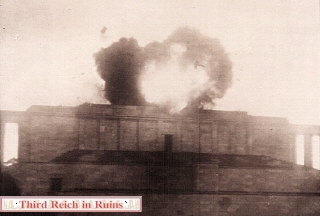
The U.S.
Army blew the swastika from the top of the Zeppelintribüne on 25 April
1945, shown in this sequence of Army Signal Corps photos (a similar
motion picture also exists). (National Archives Record Group
111-SC, #205199-205201) (Watch the film on YouTube at http://www.youtube.com/watch?v=xEAo7JnDm_I
- thanks to Willem Oosterhof for the link.) |
|

|

|
| The
Zeppelintribüne as it appeared in April 1945, and a similar view as it
appears today. The dark mottling on the steps in 1945 was from bricks
placed in patterns as camouflage. (National Archives Record Group 111-SC-205454; courtesy
Digital
History Archive) |
 |
| Above, a
GI's photo of the
Zeppelintribüne in July 1945, still with camouflage pattern bricks on the
steps. Below, GI photos from July and August 1945. The August photo
shows the view after the site was cleaned up and the grandstand
decorated as SOLDIERS' FIELD with a Third Army symbol. |
 |
 |
 |
 |
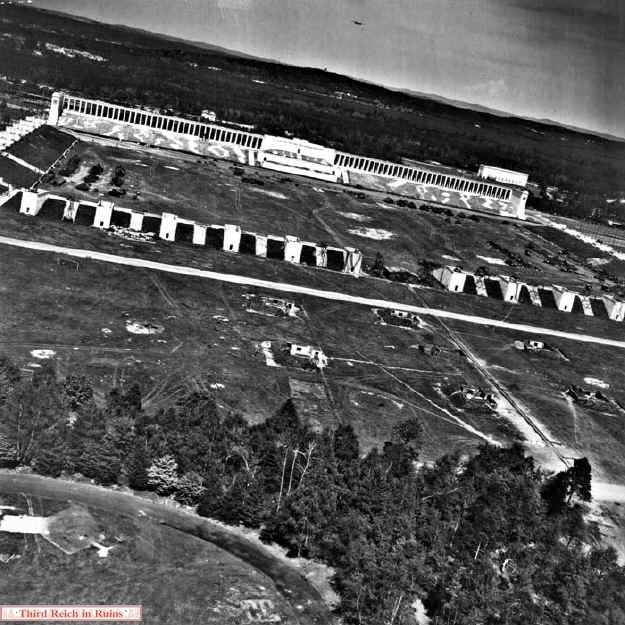
| These remarkable aerial photos
show the
Zeppelinfeld in May 1945, very shortly after the end of the war.
The large swastika has already been blown off the top of the Tribüne, but the stairs
still show the camouflage patterns (a rather futile effort). In the lefthand photo, the Umspannwerk transformer building is visible over the
right edge of
the Tribüne, and several anti-aircraft gun emplacements appear in the foreground.
Craters from bombs or artillery shells can also be seen. (U.S.
Army photos. National Archives RG 342FH) |

This color photo was taken in 1960, before the colonnades and end structures were
demolished. (courtesy Jim Walsh)
 |
 |
| Two
unusual color slide views from 1964, showing the front and back of
the
Zeppelintribüne before the colonnades and end structures were
demolished. (private collection, used by permission) |
Click here
to visit a page featuring a virtual tour of the Nazi Party Rally Grounds.
Click here
to visit the "Geschichte in Stein" page, with excellent photos of the
Party Rally Grounds and other ruins in the Nürnberg/Erlangen area.
Click here
to visit the "Bauten in Nürnberg 1933-1945" page, with in-depth
coverage of Third Reich buildings in the area.
 Continue to Nürnberg Part 3 - Nazi Party Rally Grounds (cont.),
featuring the Kongreßhalle, Deutsche Stadion, Große Straße, and water tower for the
Parteitag camps. Continue to Nürnberg Part 3 - Nazi Party Rally Grounds (cont.),
featuring the Kongreßhalle, Deutsche Stadion, Große Straße, and water tower for the
Parteitag camps.
 Back to the Third Reich in Ruins homepage Back to the Third Reich in Ruins homepage

|